


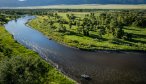
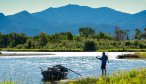
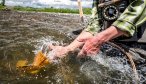
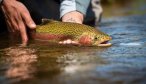
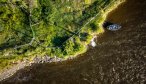
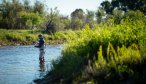
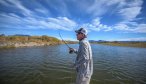
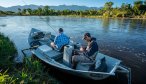
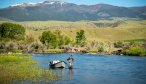
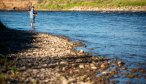
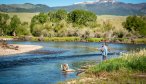
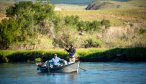
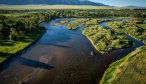
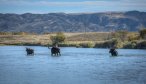
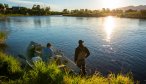
The Jefferson River fishing is overlooked by many visiting anglers. The "Jeff" is a large river that is formed by the confluence of the Beaverhead and the Bighole in Twin Bridges. The Jefferson is one of the three forks that form the Missouri along with the Madison River and Gallatin River. Fly fishing the Jefferson is never a crowded experience. The river travels through one of Montana's most picturesque valleys. Trout numbers are lower than some of the other blue ribbon rivers in the region resulting in lower average catch rates than some of its sister watersheds. Despite the lower trout density, the Jefferson can produce some outstanding fishing under the right conditions.
The Jefferson is a large river and its flows fluctuate greatly over the course of the season. We like to target the "Jeff" in the spring before runoff has started, just after runoff and again in the fall. We also consider a day on the Jefferson when the midsummer heat is broken by an early cold front that brings cool rainy weather. Due to the fact that the river has a lower trout concentration it is important to catch this fishery when conditions are optimal, otherwise you will be in for a very slow day. Several seasons of abundant snowfall have produced excellent water conditions and trout numbers have been bolstered as a result. Drought years hit the Jefferson hard which contributes substantial flows to irrigation. Trout Unlimited has been working hard to improve flows on the river during low water conditions.
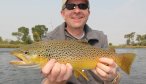
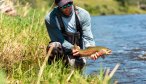
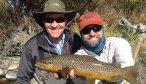
The Jefferson is a bit of a drive from some of the major guiding centers and as a result most Ennis and Bozeman fishing guides have a difficult time passing up more famous fisheries that are closer. The Jefferson is a river that many of our guides head to on a day off however. The appeal of spending a day on a river with few other fisherman and monster trout is an elixir that many locals and visitors find difficult to resist. Because the river receives very little fishing pressure relative to its neighbors, its large trout are less wary and easier to hook.
Jefferson River from Twin Bridges to Cardwell
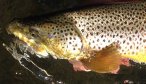
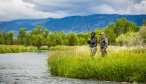
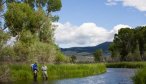
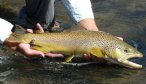
The upper section begins at the confluence of the Beaverhead and Big Hole River near the town of Twin Bridges, Montana. From there, the Jeff travels 50 miles through a large open valley dominated by hay fields and cottonwoods. The picturesque Tobacco Root Mountains shoulder the East side of the river for the duration of this section. Large territorial brown trout reside in the seemingly unlimited number of deep undercut banks, brush lined back eddies, and large riffles. Streamer fishing these types of structures can be euphoric if you catch the fickle Jeff at the right time. Healthy populations of rainbows have been returning to the upper section following concerted efforts by landowners and Trout Unlimited purchasing and returning water flows to more sustainable levels.
Jefferson River Canyon
Below Cardwell, the Jefferson cuts directly through the north end of the Tobacco Root Mountains exposing awesome limestone and sandstone canyon walls riddled with geologic formations. The river narrows and slows into long deep pools throughout the seven-mile long Jefferson Canyon.
Jefferson River Canyon to Headwaters State Park
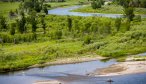
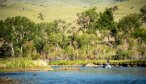
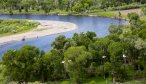
As the Jefferson exits the canyon, it resumes its journey through hay fields and cottonwoods. The river frequently varies between braided riffles, long deep pools, undercut banks, and islands. The lower Jefferson fishes consistently well during years with good snowpack, but agricultural dewatering can make it nearly impassable during drought years. Biblical proportions of grasshoppers residing in the hay fields along the lower stretches of the Jeff can make for a good day of top-water fishing in late summer. Catch rates usually aren't off the charts this far down but the average size of large fish makes for an agreeable trade-off.
Fishing the Jefferson by time of year
Spring (March - May)
Anglers will need to wait for the ice to release and the water temperatures to increase before spring fishing on the Jefferson picks up. Once water temperatures begin to climb, anglers have a fair shot at good streamer fishing during warm overcast days (typically caused by a warm front this time of year). Large streamers in black, white, olive, yellow, and brown are a good choice. Vary the direction, depth, and pace of retrieve in order to determine what elicits the most strikes. Explore using retrieves utilizing sink tip as well as floating line.
Run off (Mid May - Late June)
Predicting the end of the run-off on the Jeff can be challenging because it drains a large watershed including the Big Hole, Beaverhead, and Ruby Rivers. Streamer fishing and nymphing the Jefferson once it "greens up" can be rewarding.
Summer (Mid July - September)
The Jefferson nymphs pretty consistently with standard attractor nymphs throughout the summer. Hopper patterns and assorted terrestrials are a good way to spend the afternoon. Agricultural dewatering takes a significant toll on the Jefferson. The river fishes well when the previous winter supplied a large snowpack, however your focus may be better spent elsewhere during drought years.
Fall (October - November)
The Jefferson is characterized by some of the best streamer fishing around in autumn, however bright sunny days should be avoided. Large streamers in black, white, olive, yellow, and brown are a good choice. Vary the direction, depth, and pace of retrieve in order to determine what elicits the most strikes. Explore using retrieves utilizing sink tip as well as floating line. Watch water reports for sudden increases in volume greater than 150cfs due to local farmers closing irrigation ditches for the winter. These sudden changes will likely put fish down for two or more days as a response.
Winter (December - March)
The Jefferson becomes slush filled and closed for business sometime in early December.