

Few places in the world are as synonymous with great fly fishing as Bozeman, Montana. Within an hour’s drive of Bozeman, anglers have their pick of the Yellowstone, Gallatin, Madison, Missouri Rivers, the Paradise Valley Spring Creeks, and dozens of smaller creeks and rivers, plus a variety of lakes. Many of these fly fishing options near Bozeman are available year-round, but the summer months of June, July, and August are often the target for many anglers looking for the best fly fishing near Bozeman, with June slowly gaining popularity as one of the prime times. Here is our guide to fly fishing near Bozeman during June.
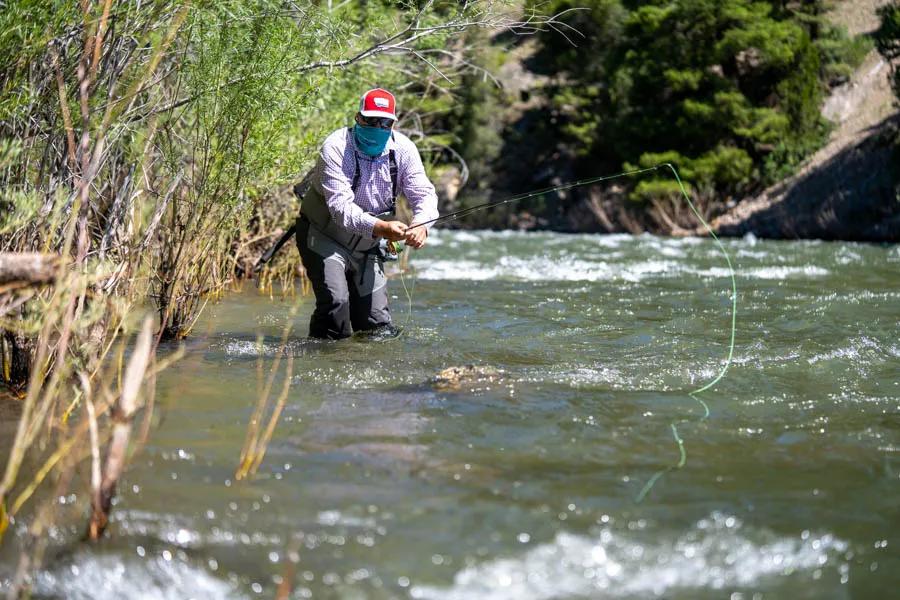
Rivers
Knowing exactly when in June the fly fishing rivers near Bozeman will be at their best isn’t an exact science. Seasonal weather patterns, snowpack, and short-term weather all play a role. Below is an outline based on decades of experience from some of Montana’s best fishing guides:
Gallatin River—in Yellowstone National Park to confluence with Jefferson and Madison Rivers. Fishable June 5th/10th and on.
In most years, fishable by the second week of June. Because much of the fly fishing on the Gallatin River is walk-and-wade fishing, anglers here need to always check locally to ensure the river is at a safe level for wading. Because the average annual peak streamflow occurs around June 10, by the second week of June, the day-to-day forecast is the best gauge for when the river might come into form. When it does drop and clear enough to fish—typically below 2,000 cubic feet per second (cfs) and with about 12 inches of visibility—the river is one of the best freestones in Montana. In June, the most consistent fishing occurs on the river around Big Sky, Montana. Once the river enters the Gallatin Valley, streamflows tend to still be too high and fast for consistent fishing.
Anglers planning to fish the Gallatin River in June can expect a river that is full, high, a bit off-color, and fished best from the bank. Water clarity on the Gallatin River in June rarely improves past a few feet of visibility, but because the Gallatin River is full of stonefly nymphs, the trout hang close to the bank. The river clarity often takes on an olive green hue. This dark greenish color is referred to by locals as “Gallatin Green.” And, as green means go, so it goes for the Gallatin River…and expect a river in prime shape.
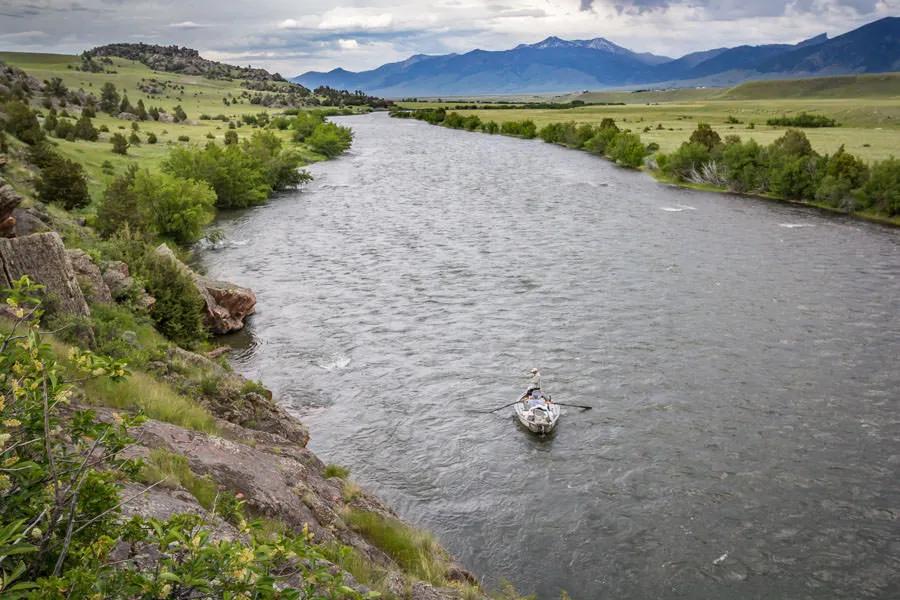
Madison River—Lower section near Bozeman. Fishable all month.
Fishable throughout June due to its tailwater nature. However, the section below the Blacks Ford can become muddy if smaller tributaries are bringing mud into the river. Because Lower Madison flows originate from outflows created by the Madison Dam on Ennis Lake, the river downstream of Ennis Lake must be treated differently. Ennis Lake is a shallow lake, and as the angle of the sun gets steeper in late June, the direct sunlight warms the shallow water of Ennis Lake. These warmer waters then flow through Madison Dam and downstream, creating warm and less favorable water conditions for prolific hatches and actively feeding trout. By late June, many anglers forgo the Lower Madison River due to high water temperatures and focus entirely on the river above Ennis Lake.
Madison River—Upper section above Ennis to Quake Lake. Fishable all month.
Even during periods of snowmelt runoff, this section is rarely unfishable due to clarity or high flows. Because Hebgen Dam and Quake Lake create this tailwater river, the Madison River above Ennis is a reliable fishery for fly fishing near Bozeman in June. The Madison River fishes differently in early June compared to later in the month. Mountain snowpack continues to melt and create muddy and full-flowing rivers in early June. In some years, it can continue into the middle of the month, but by June 15, stream flows are dropping. Depending on flows and clarity, a typical day in early June will be entirely different than later in June. Early June has most anglers fishing weighted two-fly nymph rigs. Choose one stonefly nymph in sizes 4 through 8 and one prospecting nymph such as a Pheasant Tail or Prince in sizes 10 or 12. Hatches of caddis may occur early in the month; streamflows and clarity will determine the viability of fishing the hatch.
As snowmelt runoff begins to subside, typically sometime between June 15th and 20th, the fishing transitions from exclusively subsurface to dry fly friendly. Hatches of salmonflies can begin in mid-June, and anglers can fish large dry flies with stonefly nymph droppers. From the start of the salmonfly hatch and through the remainder of June, anglers will see hatches of Golden Stoneflies, caddis, and PMDs. Most successful days begin fishing weighted two-fly nymph rigs below a strike indicator. As stonefly and PMD nymphs become more active, a dry dropper rig will begin to catch fish. Fishing with a size 6 through size 10 high-floating dry fly and a size 8 through 12 weighted nymph is useful. Depending on the hatch—stoneflies, PMDs, or caddis—opting for a single dry fly and targeting specific water can be quite a fun way to enjoy June dry fly fishing on the Madison. Target the banks or mid-river structure if stoneflies are hatching, and target riffles, shelves, and runs if PMDs are out.

Yellowstone River—downstream of the Yellowstone National Park boundary. June 28th and on.
For the past decade or so, the Yellowstone River has been fishable during the last week of June. Historically, anglers don’t expect to fish the Yellowstone River until the first week of July. Each year is different on the Yellowstone due to seasonal weather patterns, snowpack, and short-term weather. Anglers shouldn’t expect the Yellowstone River to become fishable until the first week of July, but that is slowly changing to it being fishable by the last week of June.
Because the Yellowstone River is often high and fast, with stream flows ranging from 6,000 cfs to 10,000 cfs, nearly all fishing is done from boats. If the river drops and clears and becomes fishable by the last week of June, two-fly weighted nymph rigs will produce fish as the river transitions to clearer water. Because water clarity is rarely more than 12 inches in late June, fish strong tippets and expect to lose plenty of flies to submerged structure. As hatches of salmonflies give way to Golden stoneflies and caddis, dry flies will be successful. Choose large stonefly and attractor patterns in sizes 4 to 10.
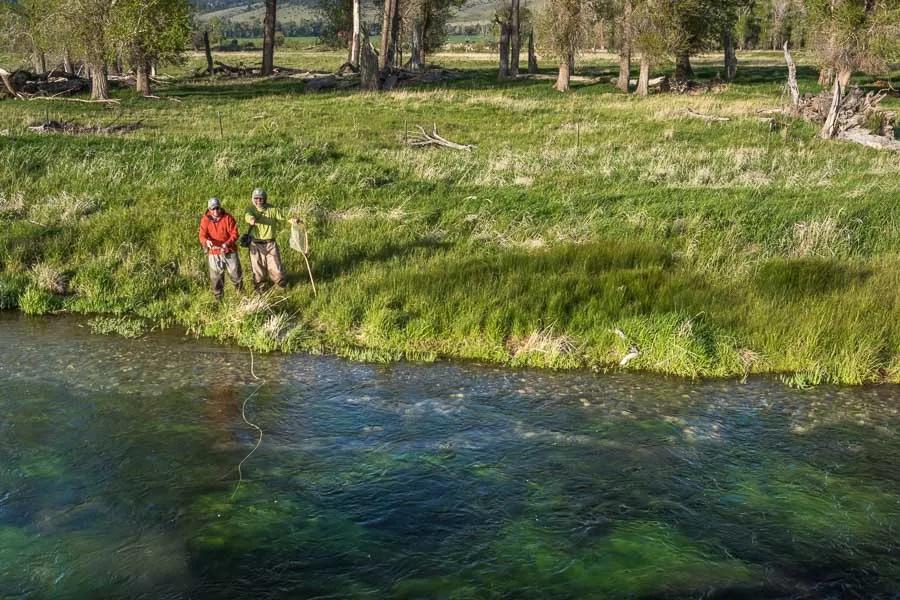
Paradise Valley Spring Creeks—near Livingston. All month, but best mid-June and on.
The two main creeks, DePuy’s and Armstrong’s, flow at the same rate and temperature 365 days a year. Because they originate from a large freshwater spring, the creeks are unaffected by snowpack and seasonal weather patterns. In fact, for dedicated dry fly anglers, mid-June on the spring creeks is probably the most reliable event in all of fly fishing—the annual hatch of Pale Morning Duns (PMDs) on the Paradise Valley Spring Creeks. Sometime between June 15th and June 20th, PMDs will begin to emerge, increasing in frequency as July approaches. Anglers desiring to fish this hatch do not need to start early, as most PMDs will begin to emerge around 10 AM, with the bulk of the dry fly action occurring a few hours after emergence begins.
PMDs are small, yellowish colored mayflies that emerge from shallow flats, runs, weed beds, and riffles. The small cobble and abundance of weed beds on DePuy’s and Armstrong’s spring creeks create an ideal habitat for massive populations of PMDs. For anglers desiring to fish small dry flies on small, calm water, fishing the PMD hatches of late June on the Paradise Valley Spring Creeks has no other comparison in the angling world.
Small streams and smaller tributaries. Varies by elevation and stream characteristics.
Because there are so many small streams and smaller rivers accessible for fly fishing near Bozeman, it is a good idea to fish the spring creeks and tailwaters before venturing to smaller freestone streams until later in June.
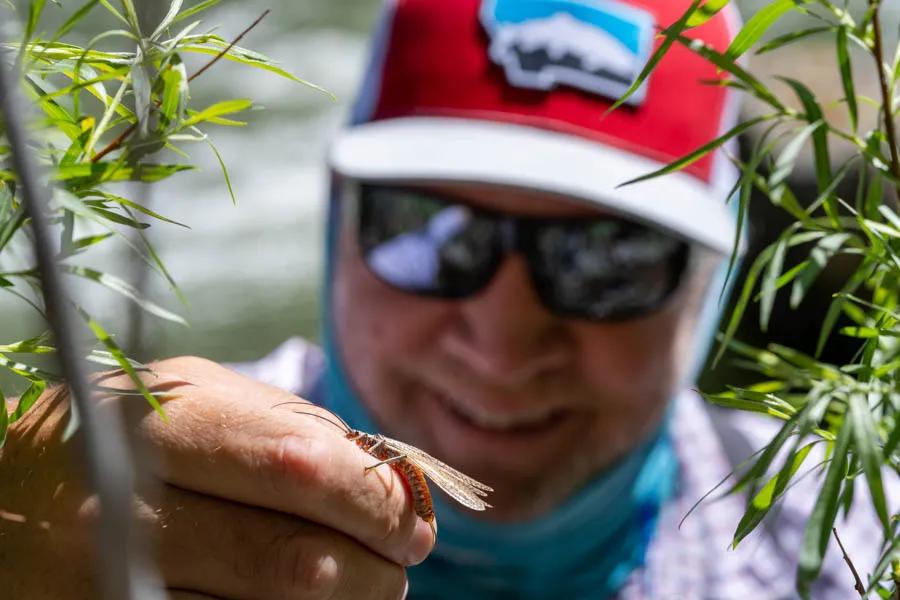
Hatches
June is the most prolific month for hatches when fly fishing near Bozeman. The famous salmonfly hatches on the Madison, Gallatin, and Yellowstone Rivers steal most of the headlines and for good reason—salmonfly naturals are big, and seeing a large trout eat your salmonfly dry fly is exciting. On most of the rivers listed above, salmonflies are the first big fly to hatch just as snowmelt runoff is subsiding.
Being able to fish the salmonfly hatch on rivers near Bozeman is a matter of timing—as snowmelt runoff wanes and rivers must drop enough so trout can hold tight to the bankside structure to feed. Caddis and golden stoneflies can hatch at the same time as salmonflies, but will last longer. In fact, during a salmonfly hatch, many experienced anglers find the fishing with caddis and Golden stonefly patterns to be better than the fishing with salmonflies. When fly fishing in June near Bozeman, Montana, after the salmonflies are done hatching, hatches of caddis, Pale Morning Dun mayflies, golden stoneflies, and Yellow Sally stoneflies dominate the hatch chart and the diets of hungry trout.
Weather
The weather in June for fly fishing near Bozeman is varied. Because June is often the early to mid-summer transition month, the weather during the first week of June is often different than the last week of June. During early June, the daily high temperature hovers around 70 degrees F, while later in the month, average daily high temperatures tick close to 80 degrees F. Later in the month, the prevalence of sunny days far outweighs overcast days. Because the weather is varied in June, so are fishing conditions. If the first half of June is cold and rainy, snowmelt runoff on many of the area’s freestone rivers is delayed. If the first half of June is warm and dry, snowmelt runoff may happen sooner, and rivers like the Gallatin River near Big Sky and Bozeman can be fishable sometime before June 10th, and the Yellowstone River flowing out of Yellowstone National Park can be fishable as early as June 20th.
If you live in the area or are planning a fly fishing trip to Bozeman, Montana, choosing the best time and where to go fly fishing in Montana can feel intimidating, but there really isn’t a wrong choice when choosing the fly fishing near Bozeman. Tack onto this Hall of Fame lineup of fly fishing rivers, lakes, and streams, the abundance of world-class fly fishing guides and purpose-built fly fishing lodges, and you can easily see why going fly fishing near Bozeman is at the top of many anglers’ lists.