

The Smith River is a small to medium-sized freestone river providing perhaps the best mix of beautiful scenery, consistent hatches, and a variety of fish habitats and stream characteristics in Montana. If fly fishing in Montana is known for broad valleys with views that go on for miles, rugged canyons with picturesque rivers, and waters that are home to several species of wild and native trout, then the Smith River epitomizes the many great things about fly fishing in Big Sky country. Beginning in the late 1980s, Montana officials recognized the unique quality and value of the Smith River as a recreational paradise. In 1989, the Montana Legislature Passed the Smith River Management Act. This collaborative piece of legislation provided essential foresight into managing the one-of-a-kind resource that is the Smith River. Here is our Guide's Guide to Fishing the Smith River.
Overview of Fly Fishing on the Smith River
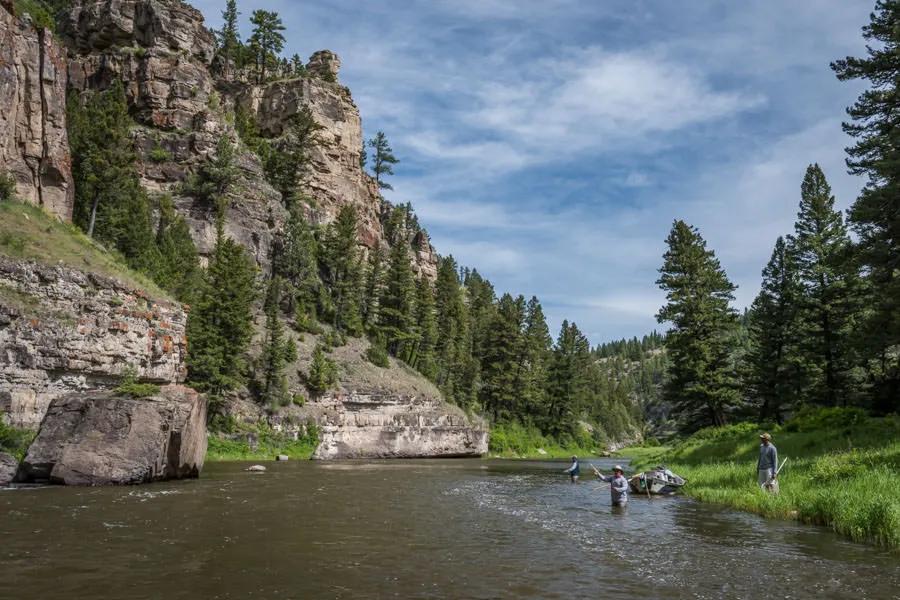
A fly fishing trip on Montana's Smith River is a trip every angler should experience at least once in their lifetime. As one of the premier specially permitted floating and camping rivers in the United States, the Smith River's fishing and quality of experience have been preserved and enhanced for decades. Nearly all of the fly fishing on the Smith River occurs in the 60-mile section from Camp Baker to Eden Bridge, where the river cuts through a ruggedly beautiful limestone canyon. The river is a small to medium-sized freestone river with a unique seasonal nature. Because the headwaters of the Smith River are heavily irrigated, the main season for floating, camping, and fishing on the Smith is during the months when streamflows are the highest and most favorable for floating and fishing conditions--April through mid-July and again in late September and October.
The Smith River is also unique to many freestones because even during times of muddy or high water that often occur during snowmelt runoff, trout on the Smith River continue to feed. Because of this, there are very few days during the Smith River's angling season when the river is truly unfishable. The Smith River offers some of the most unique, diverse, and consistent freestone river fly fishing in Montana and the West. It has prolific hatches of Blue Winged Olives, Drakes, stoneflies, caddis, and plentiful terrestrials, which help feed its abundant populations of wild brown and rainbow trout and native Westslope cutthroat trout and Mountain whitefish. The Smith River canyon is one of the most scenic fly fishing rivers in Montana as it cuts it way through the Big Belt Mountain range. The impressive scenery, high trout counts, potential for trophy fish, and proximity to Yellowstone National Park make this a must-fish river for every serious fly fisherman.
Hatches for Fly Fishing on the Smith River
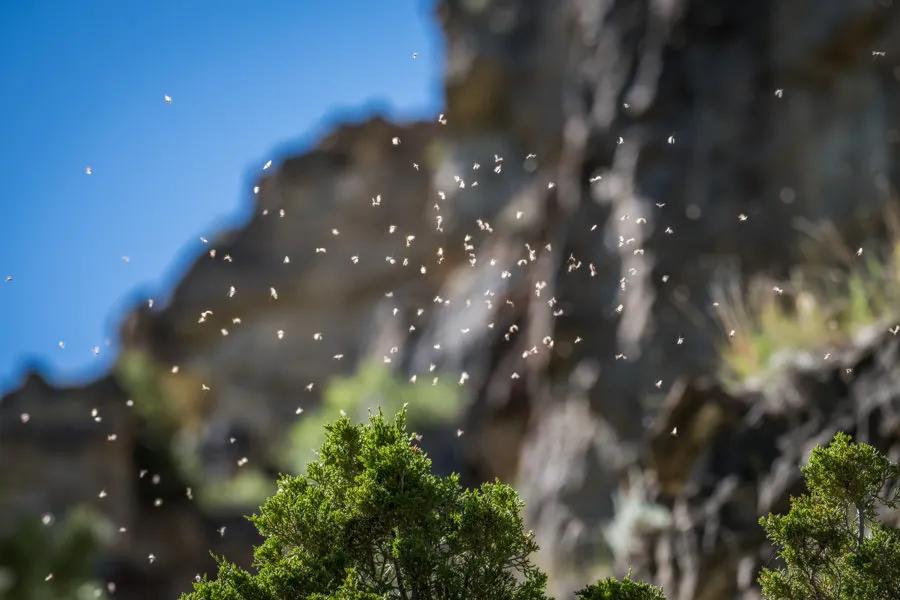
Although the Smith River is a smaller-volume freestone river, it has surprisingly prolific hatches. The Smith is a lower elevation system relative to some of the larger rivers in Southwest Montana, and many of its hatches occur a bit earlier as a result. The best early-season hatches occur just before, during, and after runoff. Anglers can often enjoy some great dry fly fishing in the pre- and post-runoff windows. Summer fishing is often dependent on water temperatures, but terrestrial fishing can be excellent when water temperatures are cool. Strong terrestrial fishing extends into the fall, along with some nice fall blue-winged olive hatches in October.
Blue Winged Olives (BWOs)
Beginning in late March and lasting through May and again in mid-September, lasting well into October, these mayflies can hatch on any day during those two seasonal windows. Overcast days may see the strongest emergence, especially on the river downstream from the confluence with Rock Creek, all the way down to where Deep Creek joins the Smith River. Sunny days can experience very strong hatches as well, but the ideal BWO day on the Smith River is overcast, with scattered showers, and air temps in the low 50s. Spring BWOs range from size 14 to 16, and fall BWOs range in size from 16 to 22.
Western March Browns
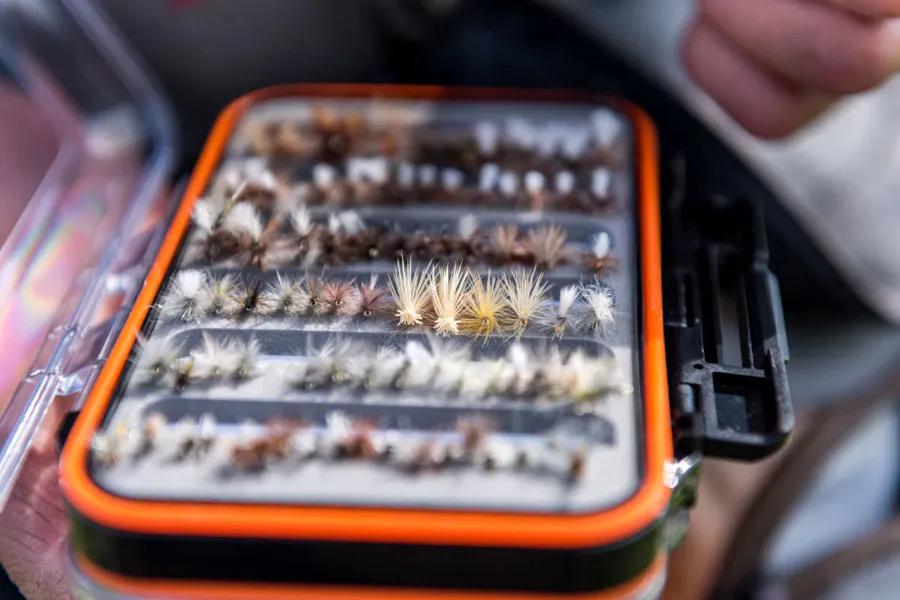
March Brown hatches on the Smith River are very sporadic. They can hatch on the entire length of the river in late April and can be seen throughout May as well, but conditions must be ideal—overcast, water temperatures between 44 and 48 degrees F, and very light winds. If these conditions on the Smith River occur, a large emergence of March Browns can happen, making these large mayflies easy pickings for hungry trout. March Browns on the Smith River range in size from 12 to 16, with most being size 14.
Skwala stoneflies
The earliest stonefly hatch of the season, the skwala, emerges in random fits and spurts on the Smith River. Unlike salmonfly and Golden stonefly hatches, where hundreds of adults can be seen fluttering in the air, a skwala emergence is subtle, with only a few adults spotted airborne. But because these large insects hatch early in the season, opportunistic trout may rise to a well-presented dry fly. Most adults are size 8 and 10. Skwala nymphs are active year-round, and most stonefly nymph patterns can imitate a skwala.
Caddis
Caddis on the Smith River hatch from late April through August, with strong hatches in early May, June, and July. The Smith River is home to a large number of caddis species and has a well-known Mother's Day caddis hatch. Attempting to name them all would be cumbersome and not necessary for catching more fish. Caddis nymphs on the Smith River are active year-round and run from size 10 to 22. In late summer, evening caddis hatches provide camping anglers an enjoyable end to a special day floating the Smith River.
Salmonflies
Depending on when snowmelt runoff occurs, the salmonfly hatch on the Smith River can be a boon or a bust to anglers floating and camping on the river. A salmonfly hatch on the Smith River occurs over the course of a few days, and in some years, a few weeks. Nymphs crawl to the bankside structure and remove their outer shell—also known as their shuck. When this occurs, an adult insect, complete with legs and wings, emerges. This typically occurs when water temperatures range between 54 and 58 degrees F; however, this can also coincide with the start of snowmelt runoff. Fortunately, trout on the Smith River are accustomed to muddy water and can feed heavily when river clarity is poor. Weather, sunlight, and streamflow are all factors in the quality of fishing during a salmonfly hatch.
Golden stoneflies
On the Smith River, Golden stoneflies provide plenty of action for dry fly anglers. These insects are size 8 to 12 and usually emerge slightly later than salmonflies. In some years, they can hatch in early June and last into mid-July. A Golden stonefly hatch occurs in the same sequence as a salmonfly hatch; however, golden stoneflies are smaller. Golden stoneflies are equally important to trout as salmonflies; they just don’t have the same celebrity status because they are the second species of stoneflies to hatch after runoff.
Yellow Sally stoneflies
These stoneflies may hatch concurrently with salmonflies and Golden stoneflies. Often mistaken for caddis or PMDs, this small stonefly is a crucial part of a Smith River trout’s diet. Yellow Sally stonefly nymphs become active in early June, with adult insects hatching from early June well into July. Yellow Sally nymphs range in size from 8 to 16, with size 10 and 12 being the most common. Because adult Yellow Sallies have very sporadic flying habits, trout rarely key on them, making fishing dry flies difficult, but the nymphs are consumed on a daily basis.
Brown and Green Drakes
Drakes, both brown and green, hatch on the Smith River in June. Drakes are large mayflies, hatching when the water temperature hovers around 55 degrees F. Brown drakes begin to be active around 50 degrees, but it isn’t until 55 or 56 degrees F that enough adults hatch on the Smith River to entice trout to rise. Because the Smith River carries a lot of natural sediment, brown drakes are more prevalent than green drakes, as brown drake nymphs prefer very fine sand and gravel. Most adults are size 14, with a few size 12 and 16 naturals on occasion.
Pale Morning Duns
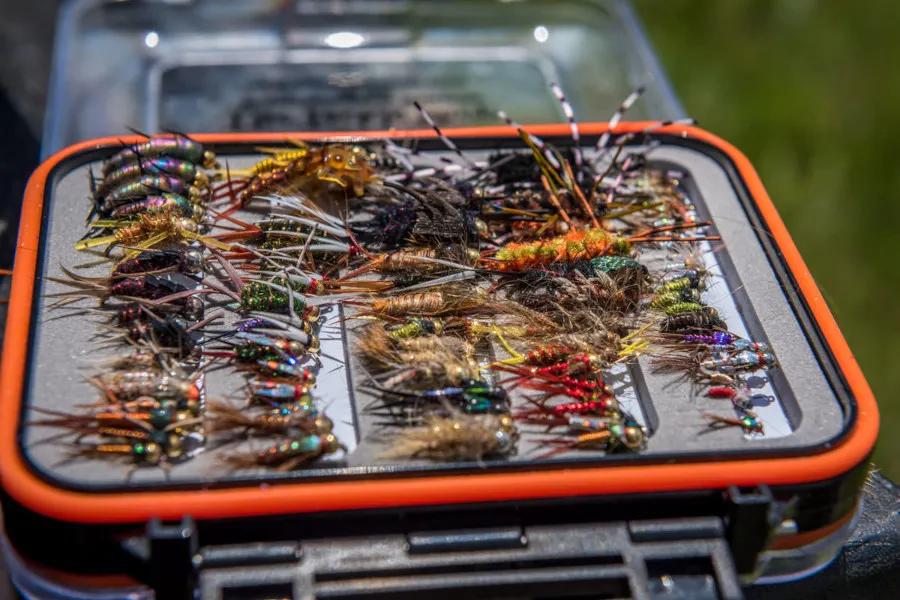
These summer-time mayflies hatch in abundance on the Smith River. Pale Morning Dun (PMDs) begin to hatch in mid-June and last all through July. Primarily found in the river’s riffles and longer runs, PMDs emerge when water temperatures hit 58 degrees F. PMDs hatch on sunny or overcast days on the Smith River, and they can hatch in either condition. Nymphs are available to trout year-round, but during a hatch, the hatching insects require time to allow for their wings to dry before taking flight, therefore being easily available to a sipping trout.
Spruce Moths
Emerging as early as mid-July or as late as mid-August, flights of hatching spruce moths cannot be mistaken for anything else. Fluttering near pine trees and bankside bushes, Smith River trout can be overly opportunistic during a strong spruce moth emergence, creating plenty of dry fly fishing opportunities for anglers lucky enough to be fishing the Smith River in late July or August. Most spruce moths are size 14 or 16.
Trico mayflies
Although not a major hatch on the Smith River, tricos offer something for anglers desiring small fly, technical dry fly fishing. Tricos usually hatch at sunrise in late July and throughout August. An emergence rarely lasts longer than a few hours. Adult tricos swarm in mating swirls above the water. After mating, they fall to the water and die, creating “spent” mayflies, also called “spinners” by many anglers.
Terrestrials: Grasshoppers, ants, and beetles
As the heat of summer grows and hatches become more sporadic and less predictable, trout look to land-based insects for food. Grasshoppers, ants, and beetles dominate a trout’s diet by late July. Having been blown into the river, these land-dwelling insects are a common occurrence on the Smith River. Once on the water, they become easy prey for hungry trout. Most grasshoppers are sizes 8 to 12, and most ants and beetles are size 14 to 18. Colorations vary, but natural tones like gray and tan tend to fish better than bright colors.
October caddis
October caddis can hatch as early as late September and will typically peak in late October. Compared to other hatches, the emergence of October caddis is limited to a few flying insects in a given section of the river. But an opportunistic trout may feast on one of these large caddis species if it happens to float by at the same time a fish feels hungry. Most October caddis are size 8 to 10.
Sections for Fly Fishing on the Smith River
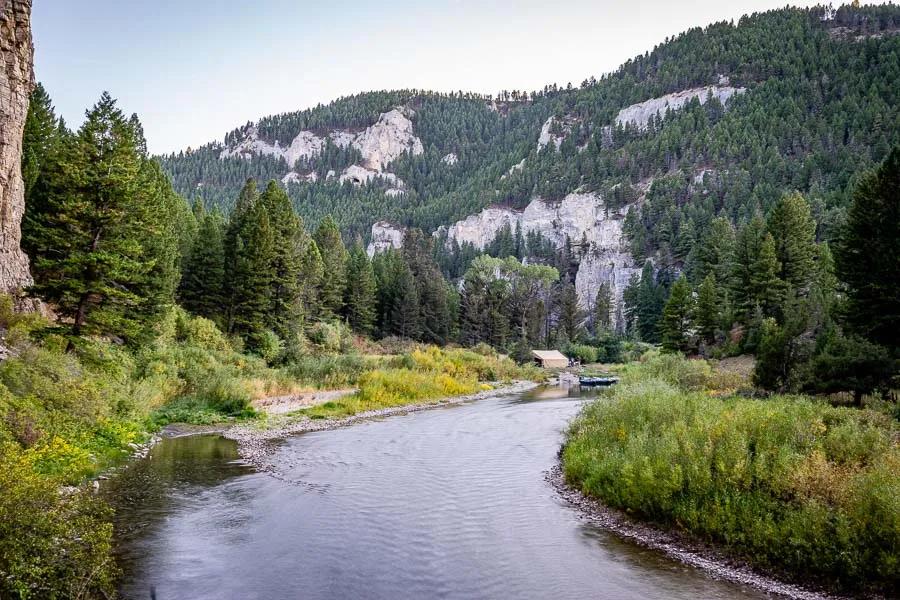
Montana's Smith River begins in the Little Belt, Castle, and Big Belt Mountain Ranges in central Montana. Beginning where the North and South Forks of the Smith River meet west of White Sulphur Springs, the Smith River flows as a small meandering meadow river flanked by heavily irrigated fields. Once the Smith River is joined by Eagle Creek, the famous section of the Smith River begins. For the next 40 or so miles, the Smith winds through a ruggedly beautiful canyon, then for the last 20 or so miles flows in the high plains near Great Falls, Montana, before joining the Missouri River.
North and South Forks and Upper Smith
These two small, meadow streams are the source of the Smith River and flow almost entirely through private ranches. Both of these forks are small and are ideal streams for anglers who enjoy fishing tiny, meadow creeks. Home to plentiful brook trout and the occasional rainbow and brown trout, if access can be gained, these two forks offer plenty of eager trout to get most anglers happy. Most fish here can be caught on standard dry-dropper rigs. Long casts are less important than specialized mends and steeple or roll costs.
Smith River from White Sulphur to Camp Baker
The Smith River here is a small river flowing through irrigated meadows before flowing through a small canyon. Nearly all of the river here flows through private property, and float fishing is nearly impossible. This section of the Smith River can have some reliable hatches of Pale Morning Duns and Blue Winged Olives, as well as a few species of Drakes and caddis. Reports of good terrestrials in summer and streamers in fall are often heard, but access is very difficult, so little is known about this section of the Smith River.
Camp Baker to Eden Bridge
This is the well-known and specially managed section of the Smith River. For nearly 60 miles, the Smith River flows through one of the beautiful river canyons in the Western United States. In collaboration, the Montana Fish, Wildlife, and Parks, along with the Lewis and Clark National Forest, carefully manage use on the Smith River. Because of the remote nature of the Smith River, floaters must carefully choose their campsite and plan their multi-day itinerary. These carefully constructed management parameters have helped to ensure this section of the Smith River remains a remote backcountry angling destination with good fishing and preserves its pristine natural state.
Seasons for Fly Fishing the Smith River
Early Spring (Late March and April)
Because the Smith River is primarily a river fished from boats, knowledge of streamflows and river camping is crucial. On any given day in April, streamflows will rarely top 800 cubic feet per second (cfs), yet in early April, streamflows can be too low to float. For most experienced Smith River anglers, flows below 150 cfs mean large rafts will drag bottom in certain sections of the river. At flows above 150 cfs and up to 800 cfs, rafts navigate the Smith River with ease. Above 800 cfs it is strongly advised to have some rafting and rowing experience.
Most anglers spend no less than three and not more than five nights on the river. To ensure safety and enjoyment, proper planning is crucial. This includes the following: having the necessary gear, knowing how to prep and prepare meals, some rowing experience, and a knowledge of individual group dynamics. It can’t be stated enough that these things are crucial to getting the most out of a Smith River fly fishing trip. See our post about 8 of the Best Flies for the Smith River for some ideas getting your fly box together.
After knowledge of the weather and pre-trip planning is gained, the fishing in April is often quite consistent. Skwala stoneflies can provide the first dry fly fishing of the season, and Blue Winged Olive (BWOs) mayflies can be thick on cool, overcast days, which are quite common on the Smith River in April. Because brown trout predominate in the Smith River, streamer anglers in April can enjoy some solid action for trout up to 23 inches, with trout from 14 to 16 inches being the most common.
The Smith River is home to healthy populations of stoneflies, caddis, and mayflies. In April, stonefly nymphs are very active, and it is a good idea to fish a stonefly nymph as part of a two-fly weighted subsurface nymph rig or as the dropper on a dry fly-dropper nymph rig. Choose stonefly nymphs in sizes 8 or 10 and mayfly or caddis nymphs in sizes 10 to 16.
Streamer anglers should choose streamers in sizes 4 to 8 and in olive, black, brown, or black-olive combinations. Casting to structure and stripping back to the boat or casting behind the boat and letting the fly drift past structure are time-tested methods to entice a predatory brown trout into striking at a streamer.
Because water temperatures are still cold—rarely rising above 52 degrees before runoff commences—trout will be found in slower currents. Focus on the rivers' slower and deeper waters—places like inside bends, eddy-lines, and foam seams around large rocks or other structures. These “softer” waters allow for trout to expend very little energy while having access to available food.
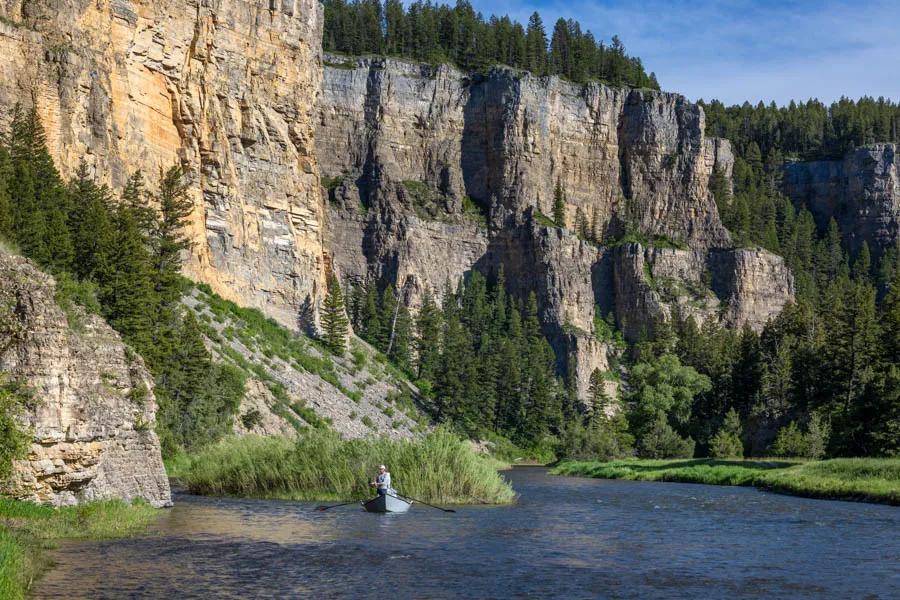
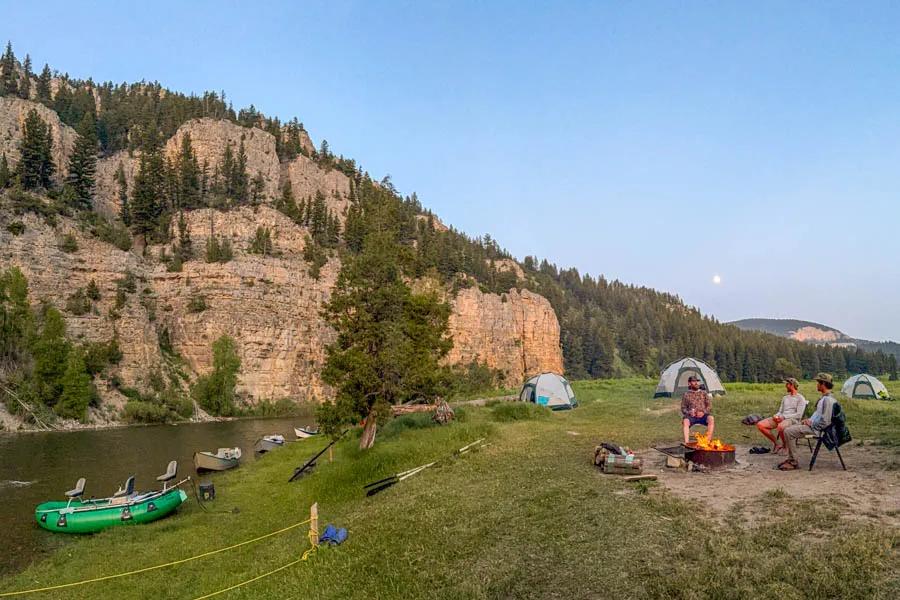
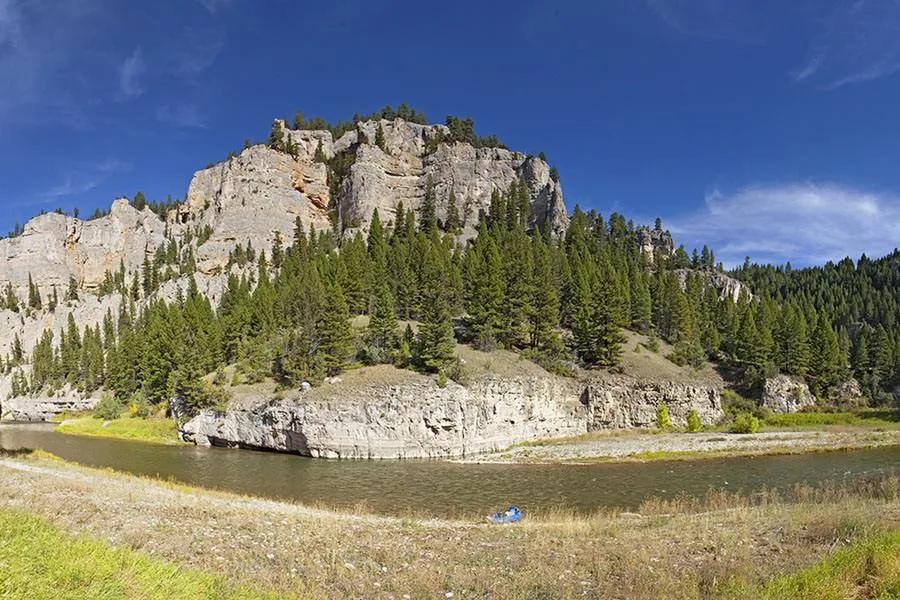
A defining characteristic of the Smith River is its towering limestone cliffs. As the river meanders through the canyon, its currents run into, against, and along the cliffs. This is an ideal habitat for trout, providing current for food and cover from predators. These canyon walls create holding and feeding lies galore. Large brown trout can be caught fishing the currents along these canyon walls, and they should be fished, but in April, many of the Smith River’s trout prefer the slower water downstream of a canyon wall or the soft inside bend across the river from the faster current along the wall.
Late Spring/Pre-Runoff (Early and Mid-May)
Because nearly all fishing trips on the Smith River require multiple overnight stays, the main access points are 60 miles apart, and anglers must apply for a permit to float and camp on the river, any fly-fishing trip on the Smith requires careful planning and a thorough understanding of river conditions and weather patterns. By May, as air temperatures warm and streamflow levels rise, flows for floating become favorable. Throughout the year, but especially in May, the clarity of the Smith River is muddier than comparable rivers. However, rarely does it have so much sediment that it is unfishable.
May in Montana’s remote Smith River is a month of variety in fishing action, weather, and streamflows. Featuring a range of daily high temperatures, fishing conditions follow suit and change rapidly. For many Smith River veteran anglers, May is the favorite month of the angling season. Salmonflies, caddis, Drakes, and Blue Winged Olive mayflies can all hatch in May. However, if snowmelt runoff commences or large amounts of precipitation fall, causing a rapidly rising river, it may be a few days before the trout adjust and resume typical feeding habits, but that doesn’t mean they cease feeding—Smith River trout continue to feed in conditions deemed unfishable on many other rivers.
The toughest conditions in May occur when the river is rising rapidly, due to hot weather or heavy rains producing rapid snowmelt. Throughout May, moderate increases in river flows occur regularly and are generally tolerated well by the trout. When the river is rising fast and gaining hundreds of cubic feet per second of added discharge from one day to the next, trout are forced to adjust their feeding lies, and they become harder to find. However, because Smith River trout feed in muddy water, persistent anglers can still find fish. After a warming event or rising in flows, as streamflows drop and stabilize, fishing quickly improves as Smith River trout adapt well to changing conditions.
The Smith River is home to a variety of aquatic insects, and in May stonefly nymphs especially are very active. Fishing a stonefly nymph as part of a two-fly weighted subsurface nymph rig or as the dropper on a dry fly-dropper nymph rig is one of the most popular rigs this time of the year. Salmonflies can hatch in May on the Smith River, significantly earlier than most of our other major rivers. It is always a good idea to be prepared for a salmonfly hatch, however, if flows are rising steadily, trout may struggle to hold in traditional dry fly lies, though weighted two-fly nymph rigs still produce. Additionally, because brown trout predominate in the Smith River, streamer anglers can enjoy some solid action for trout up to 23 inches, with trout from 14 to 16 inches being the most common.
Finding trout on the Smith River in May depends on the condition of the river. Because Smith River trout feed in muddy water, rarely does a day exist in which trout cannot be found. The towering limestone cliffs that define the Smith River canyon provide ideal habitat for trout. During May, these cliffs can be a focus of trout anglers, or they should be ignored. Large brown trout can be caught fishing the currents along these canyon walls, and they should be fished, but during the higher—and often rising flows—of May, most of the Smith River’s trout prefer the slower water downstream of a canyon wall or the soft inside bend across the river from the faster current along the wall.
If hatches of salmonflies, Drakes, or caddis occur, trout can be found near bank-side structure and foam lines created by mixing currents or other structures. In these slower waters, look for rising trout. During a hatch of caddis or Drakes, target slower currents, eddy lines, and seams behind rocks. For salmonflies, focus on bank-side structure, willows, eddies, and foamlines.
If a hatch doesn’t occur and the river has rising flows and muddy water, target slow eddies, foam lines, inside corners, and any soft water near structure with subsurface nymphs. Trout will be in lies where they can enjoy access to food floating by without spending too much energy swimming in heavy, rapidly rising streamflows.
Early Summer/Post Runoff (Late May through June)
June on the Smith River is defined by long days and prolific hatches. Because in this month the Smith River sees the end of snowmelt runoff, the fishing changes throughout the month. The first week or so can still experience high or rising flows, but in most years, by June 10, the river begins to drop rapidly. By month’s end, streamflows are low, and hatches are thick. Planning a Smith River fly fishing trip in early June is similar to the second half of May: equal parts calculated risk with equal parts for the hope of great rewards. However, a Smith River trip after the first week of June has great potential for ideal conditions. Starting a trip anytime during the second week of June is the most desired.
By early June, snowpack and streamflow data can paint a detailed picture to help forecast when the Smith River may crest and begin to drop—typically by June 5th. When it does begin to drop enough for the most favorable fishing and floating conditions—typically below 1,000 cubic feet per second (cfs) and with about 6 inches of visibility—the river is one of the best freestones in Montana for the remainder of the month of June.
Like the streamflows, June weather changes as the month progresses. Early June sees average daily high air temperatures in the mid-60 degrees F, while by the month’s end, the average daily high temperatures rise to almost 80 degrees F. Early June differs greatly from late June, both in terms of weather, fishing conditions, and hatches. Because the Smith River is a freestone river—its streamflow is directly related to available snowpack and tributary streams—early June can vary. Due to the smaller drainage and lower elevation mountains that feed the Smith, the river flow peaks earlier than on other systems in Montana.
Peak flows on the Smith generally occur in late May or early June. While flows are high in early June, in most years the river begins to stabilize by June 10. During years of lower-than-average snowmelt runoff, streamflows may even be dropping by June 1. Higher streamflows in early June generally rule out dry-fly fishing opportunities. During these high flows, this is the time for big ugly patterns, and anglers have their best luck stripping streamers or fishing nymph rigs with large, weighted flies. Pattern selection does not need to be sophisticated. Choose two fly-weighted nymph rigs with Pat’s Rubberlegs or San Juan Worms in sizes 8 through 12, Zonkers or crayfish in sizes 4 through 8, or Prince Nymphs or Copper Johns in sizes 10 or 12. For streamers, Zonkers or crayfish, along with black, brown, or olive-and-black Woolly Buggers in sizes 4 through 8, are always good choices.
Mid/Late June
The couple of weeks that make up the second half of June may be too short for longtime fans of the Smith River, who patiently wait many months to fish the river in its ideal post-runoff condition. In most years, by mid-June, the river is on a steady decline, with flows dropping each day. Water temps are very favorable, and another round of hatches kicks into gear. Hatches of Golden stoneflies, Pale Morning Duns (PMDs), various caddis species, Yellow Sally stoneflies, and a few Drakes make up the hatch chart. This is one of the most variable times of the season, and fishing conditions can change from day to day and even hour to hour. On an average water year, this is typically one of the best dry-fly windows on the Smith. In low water years, warmer water temperatures can become an issue as early as the last week of June, causing the fishing window to be best early in the morning or late in the evening—which isn’t a problem because most campsites are a very short walk from the river!
For late June fly fishing on the Smith River, choose dry flies that imitate the various hatches. Stonefly dry flies in sizes 8 through 10 in tan, gold, or yellow are ideal. For PMDs, choose mayfly dries or emergers in sizes 12 through 16. For PMD nymphs, choose beadhead Pheasant Tails in size 12 through 16. For the few Drakes that may hatch, choose mayfly dries in sizes 10 or 12 and nymphs in sizes 10 or 12.
Streamer anglers may still find a few aggressive trout in late June, particularly in the lowlight conditions of early morning or late evening. Choose olive, black, or black/brown sparsely dressed patterns in sizes 4 through 8. A black or olive conehead Sculpzilla is a guide-favorite for mid/late June.
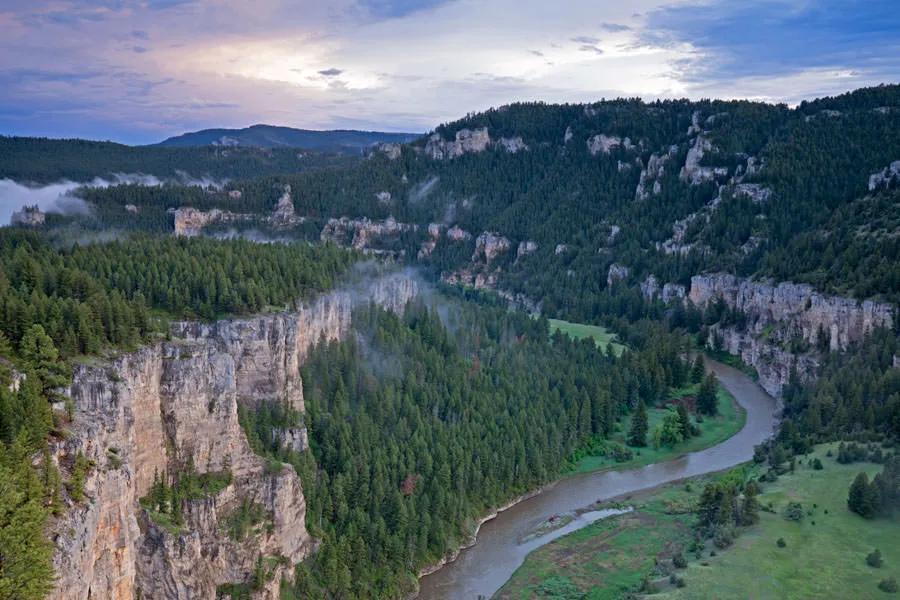
June is a month of variety on the Smith River. Because trout most often follow the available food source, where a trout may be found early in June will differ from where they may be found later in the month. The Smith River is defined by a deep limestone canyon. Limestone cliffs dominate many bends of the river, and many of the Smith River’s trout hold and feed along these limestone cliffs.
In June, these cliffs can be a focus of trout anglers, or they should be ignored. If early June experiences high and rising flows, most of the Smith River’s trout prefer the slower water downstream of a canyon wall or the soft inside bend across the river from the faster current along the wall. If flows are dropping and clear, shift focus back to the seams and eddies along and near the cliff walls.
If hatches of stoneflies or caddis occur, trout can be found near bank-side structure and foam lines created by mixing currents or other structures. In these slower waters, look for rising trout. During a hatch of caddis or Drakes, target slower currents, eddy lines, and seams behind rocks. For stoneflies, focus on bank-side structure, willows, eddies, and foamlines. For Pale Morning Duns (PMDs), target pocket water—in front and behind rocks--riffles and shelves, and long runs or flats.
In early June, if a hatch doesn’t occur, target slow eddies, foam lines, and any soft water near structure with subsurface nymphs. Trout will be in lies where they can enjoy access to food floating by without spending too much energy swimming in heavy, rapidly rising streamflows.
In mid/late June if a hatch doesn’t occur, because the Smith River has an abundance of aquatic life and streamflows are dropping, and food is prevalent in many habitats, trout inhabit many places. They are most often found along the bank, in riffles, shelves, the heads of runs, and the tail outs of runs. These habitats all offer the primary needs for trout: available food source, cover from predators, cover from strong currents, and flowing water for oxygen.
Mid Summer and early Fall (July, August, and early September)
Because the Smith River is fished primarily from boats on a multi-day floating and camping trip, the ability to float and fish the Smith River in July is entirely dependent on streamflows. The Smith River is a freestone river, so flows for July fluctuate from year to year. Anglers can count on the fact that flows will drop throughout the month of July. Because of this, if a Smith River fly fishing trip is going to occur, the best chances for it happening are in the first two weeks of July, with the best odds for sooner in the fortnight than later.
Generally speaking, the fishing can be good in this window, even if it is a low-water year, but fishing may shut off early as you move into the second week of July. On a good water year, early July fishing can be fantastic as the higher flows help to keep water temps at a comfortable level for trout. Hatches of Pale Morning Duns (PMDs) and caddis are strong at times, hatches of tricos can occur, and the potential for very good terrestrial fishing exists.
Even if the fishing action in early July can be a little less than consistent, the weather is not. Early July sees average daily high air temperatures in the high 70 degrees F, while by the month’s end, the average daily high temperatures rise to almost 83 degrees F. Measurable precipitation is only likely to fall on fewer than five days throughout the month.
Caddis, stonefly, and mayfly nymphs are active on the Smith River in July. Stoneflies will most likely be done hatching, so caddis, Pale Morning Duns (PMDs), and spruce moths may cause trout to be on the feed. If this occurs, look for trout throughout all possible feeding lies—near bankside structure, seam lines between slow and fast water, currents flowing along the limestone canyon walls, shallow flats, riffle corners, and the heads of deep pools.
July on the Smith is definitely hit or miss when it comes to fishing and floating the Smith. In most years, early July sees flows at a level conducive to floating and fishing, but as the days tick away, the flows drop, and water temps rise, creating less than ideal conditions. In a high snowpack year, the river may be floatable all summer, and good fishing can extend into late July and even August. During average water years, by mid-July, the river often drops to levels too low to effectively float (at least to float and enjoy it) and requires extensive dragging of boats.
July fly fishing on the Smith River is very different from June. If June sees the Smith River come into shape and will stay that way for most of the month, July means the Smith River starts in prime shape and slowly changes to less than ideal by month’s end.
Hatches of PMDs and caddis are often strong in early July. By month’s end, tricos and terrestrials dominate the dry fly charts. But because the Smith River is home to a variety of stonefly, mayfly, and caddis species, these nymphs are active subsurface in the height of summer. Despite the river’s healthy population of aquatic insects, water temperatures in late July often rise to undesirable levels for actively feeding trout.
If water temperatures stay in the low 60 degrees F, look for hatches of PMDs, caddis, spruce moths, and tricos. A few late-hatching stoneflies may occur, but they will be seen early in the morning. Terrestrials may be abundant as well.
For PMDs, choose mayfly dries or emergers in sizes 12 through 16. For PMD nymphs, choose beadhead Pheasant Tails in size 12 through 16. For caddis, choose dry flies in sizes 12 through 18 and nymphs in sizes 12 through 18 as well. Most caddis adults will be tan or olive in color. For the few spruce moths that may hatch, choose light or tan dry flies in sizes 14 or 16.
Because water temperatures in the low 60 degrees F, coupled with bright sunshine, are the norm on the Smith River in July, a two-fly subsurface nymph rig is always a good choice.
Even in the deep canyon of the Smith River, bright sunlight can penetrate into the water. When the sun becomes high in the sky and sunlight shines into the water, trout will move back to safer and cooler holding lies, occasionally moving to feed on a nymph floating by in the current. These trout can be found in classic subsurface lies: deeper water near shallow water, behind or in front of structure, or any place that provides cover from predators or bright sunlight.
Fall (Mid-September and October)
As the middle of September arrives, things turn the corner to the positive within a few days.
As days grow shorter, water temperatures drop to near ideal levels for trout. Around mid-September, irrigators turn off their head gates, which often results in a small but meaningful bump in streamflows. Fall trips are always a gamble on the Smith, and some years the river is still too low to effectively float. There is about a 50 percent chance that flows will be high enough to get down the river for experienced boaters for a late fall trip – it all depends on streamflows.
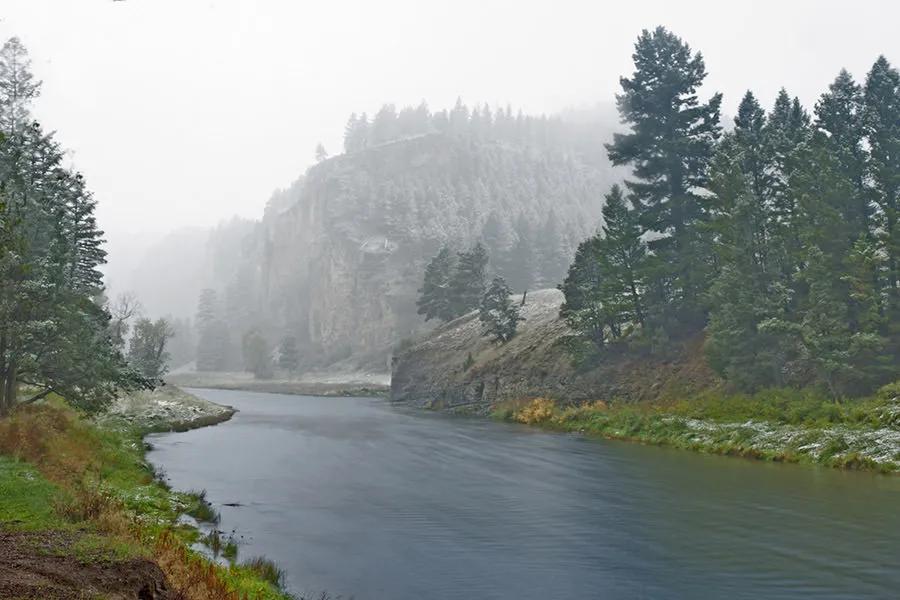
September weather on the Smith River can dish out heat, cold, rain, and snow. Daily high temperatures have a broad range—from 80 degrees F in early September to around 60 degrees F by month’s end. Precipitation is a little higher than August, piling up to about 1.5”, and the potential for the season’s first snowfall exists towards the end of the month. Because the weather is so varied in September on the Smith River, the fishing is diverse as well, with opportunities for fishing large dry flies, head-hunting trout rising to Blue Winged Olive Mayflies, or targeting large brown trout with streamers.
The fishing on the Smith River changes dramatically throughout the month. Because flows and water temperatures in early September are rarely conducive to great fishing, most anglers wait till the second half of the month.
If it is even possible, fly fishing the Smith River in early September can feel like a summer day. Fish will be active before the sun is high overhead. A few fish may rise to a well-presented caddis or grasshopper. Once the sun gets high overhead, a tandem nymph rig or slowly dragged or swung streamer may entice more fish to strike than might be willing to rise to a dry fly. Choose tan or grey grasshoppers in sizes 8 to 12. For tandem nymph rigs, choose beadhead Pheasant Tails or Copper Johns in sizes 14 or 16.
After irrigators close their headgates and cease using the Smith River’s streamflows, usually by mid-September, flows increase, making floating and fishing the Smith River canyon again viable. Fishing can be terrific in late September, with lightly pressured trout looking for grasshoppers on sunny days or Blue Winged Olives on rainy or snowy days.
For dry flies, choose grasshoppers in sizes 10 or 12, and for Blue Winged Olive dry flies, choose high-floating patterns in size 16. A proven set-up for late-September on the Smith River is a size 10 Chubby Chernobyl or PMX with a size 16 beadhead Pheasant Tail as the dropper fly. This truly is a great time to enjoy some high-quality dry-fly fishing.
As the first cold front passes through—which often does occur in late September—this brings on the start of fall, and brown trout begin to prepare for their spawn and become more aggressive. These larger trout actively seek out prey while also protecting their territory. For targeting the Smith River’s large brown trout on streamers, choose black or olive streamers or Woolly Buggers in sizes 4 through 8. These are best fished in and around structure, such as the Smith River’s canyon walls or the drop-offs into deeper water downstream of a shelf.
Trout on the Smith River in October can be easy to find…if stream flows are high enough to float and fish. If flows are above 150 cubic feet per second (cfs), floating and fishing become viable. Below 150 cfs, a trip on the Smith River is more about survival than enjoyment—more time is spent dragging a boat across shallow riffles and flats than it is spent fishing.
If a strong hatch of Blue Winged Olive (BWOs) mayflies occurs, look for trout in slower currents and “softer water” such as the inside of river bends, seams behind rocks, and slower runs below riffles. If adult insects are not seen on the water, BWO nymphs are active throughout the river. Fish a tandem nymph rig through the usual holding lies—drop-offs near shelves, seams along the limestone canyon walls, and around structure.
Brown trout can be found in the usual predator hangouts—deeper water near shallow water, hiding near structure, or along a cut bank. Many brown trout will begin to spawn in October. These spawning fish may be found on their redds on shallow gravel bars. Please avoid targeting spawning trout when they are encountered.
If sunshine is abundant and the air temperature hovers near 60 degrees F or higher, the slight possibility exists for a few trout to still target terrestrials. Trout will expend vital energy and take the risk from deep cover for a morsel as large a grasshopper, ant, or beetle. These large offerings may not pass by again that day. Fishing grasshoppers in October is a rarity, but it does happen.
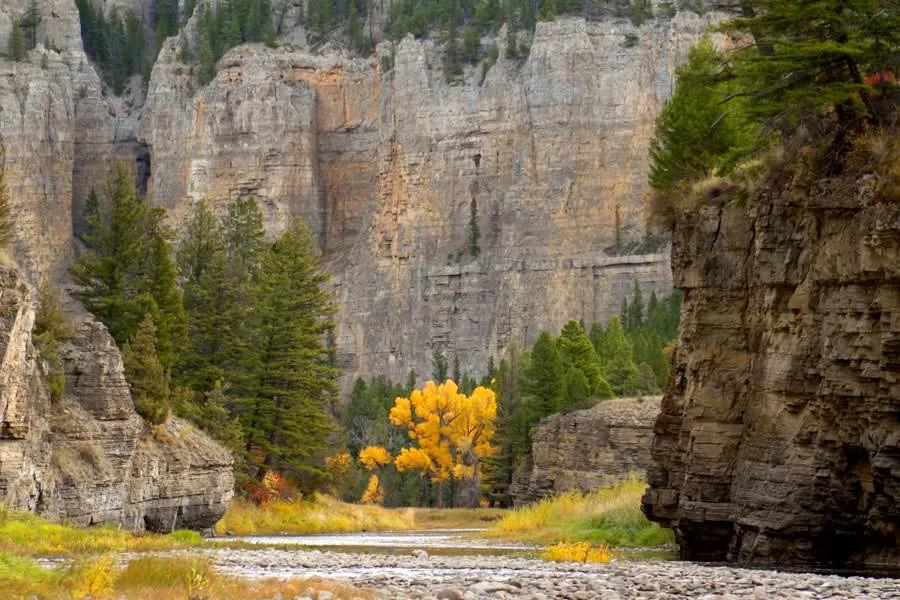
A multi-day fly fishing, floating, and camping trip on the Smith River is a yearly aspiration for many longtime Montana fly fishing guides. Because this river is specially permitted, the overall quality of experience has remained high for many decades. With Montana having so many quality fisheries, it is hard for any one river to stand out amongst them all. The Smith River epitomizes the many great things about fly fishing in Big Sky country. Not only does the Smith River flow through a gorgeous limestone canyon, but its prolific hatches and high fish counts make it one of the special fisheries that truly earns its reputation as a premier fly fishing destination.