

“This is gonna be epic, like boy band epic!” This is how one lucky Montana Angler guest described his recent trip to Aqua Boa Amazon Lodge. A quote from one of Montana Angler’s guests from our most recent trip to Agua Boa Amazon Lodge, Ted Putnam. I couldn’t agree more with that sentiment. I’ve been to Agua Boa Amazon Lodge before, but each trip seems to get more and more epic every time I go. It is just that cool.
Montana Angler hosted two week-long trips to Agua Boa this year. Brian hosted our first trip, and you can read his trip report and photo essay here. For our second trip, I was fortunate to draw the winning card, and my return trip to Agua Boa was better than my first. My first trip was spectacular, but because of the catch of a lifetime (more on that later), my second trip will live in my memory forever. I landed the biggest and coolest fish of my life, discovered a new favorite species to target on the surface, and learned what happens when a piranha finds the end of your fingertip. Not to mention the long list of new species my boat buddy Scott Lutz and I checked off the list.
Why fly fishing at Agua Boa Amazon Lodge is so exciting
One of my goals for this particular trip was to fish from the boat dock with a smaller trout-sized rod, like I do when fly fishing in Montana, and figure out how to catch pacu from the dock. It was recommended that I pack a smaller trout rod and “small” nymphs. I decided to go with a 6-weight as I didn’t want to be too undergunned if I hooked into something larger, and I brought a selection of nymphs and dry flies to try. One thing I discovered is that there isn’t a ton of free time to fish from the dock, as we get up early in the morning to eat breakfast, pack our lunches, and prepare for the fishing day ahead. There is some time in the evenings before dinner, but after a long day of fishing, it can be hard to motivate yourself to do more fishing, believe it or not, or maybe the freshly made cocktails and freshwater pool are just too relaxing.
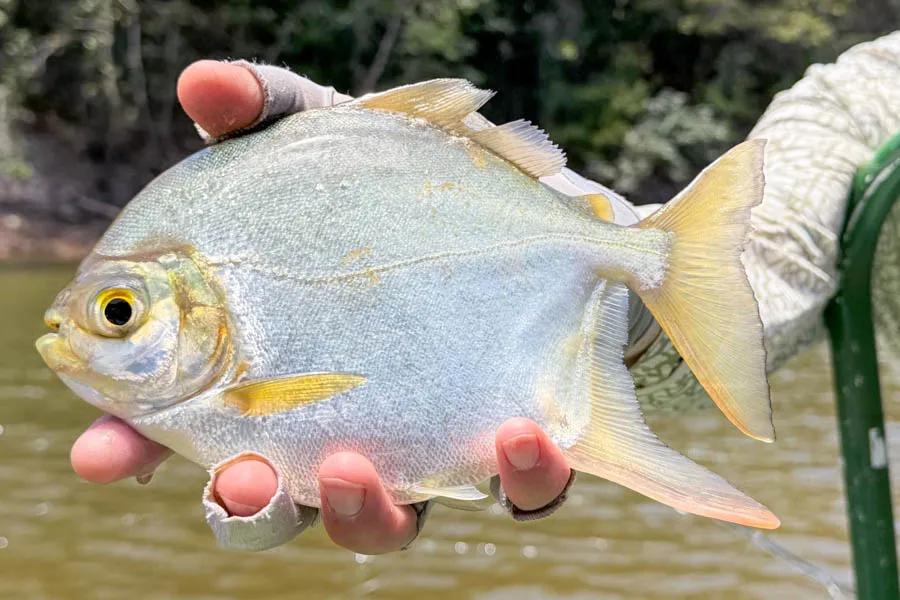
That being said, one of the mornings I was ahead of schedule and decided to head down to the dock with the 6 weight, some 3x tippet, and a puck of flies. When I arrived at the dock, there were several pacu rising, mostly about 40-80 feet from the dock, with a few feeding a bit closer. To this day, I do not know what they are feeding on. There was never an obvious insect hatch, and I have not been able to identify any bugs on the surface. I would guess they are eating something microscopic or maybe something that is small and only active just under the surface. I was hopeful to catch a fish on a dry fly, so that is where I started.
I tried a mix of several different dry fly patterns in the 12-16 range with no success. I asked one of the guides, Bacaba, what he suggested, and he told me to try a weighted nymph, cast it out, and just let it sink until the line goes tight. I tied on a beadhead Pheasant Tail, and within 10 seconds, my line was tight. It was a piranha! In the process of removing the fly from its mouth with hemostats, the fly actually broke in its mouth. I tied on a beadhead Prince next, and within 10 seconds, again I had another fish. This time it was a pacu. On the 3rd, I’m pretty sure I hooked into another piranha because after only a few seconds of playing this small fish, the line went limp, and my tippet had been cleanly broken off. I tied on a beadhead Perdigon in a larger size and had another pacu on in no time.
Montana Angler fly fishing hosted trip guest Matt Raines was watching from his boat as he waited for his fishing partner to join, so I asked if he wanted a shot. He quickly jumped up and grabbed the rod. Once again, it wasn’t long before he was hooked up. It was a piranha. Although I had a pair of hemostats in my pocket, I could see that the fly was hooked at the top of its mouth with much of the fly well outside of its mouth. I felt like I could easily grab the fly and remove it with my hands just like I’ve done hundreds of times before with other fish.
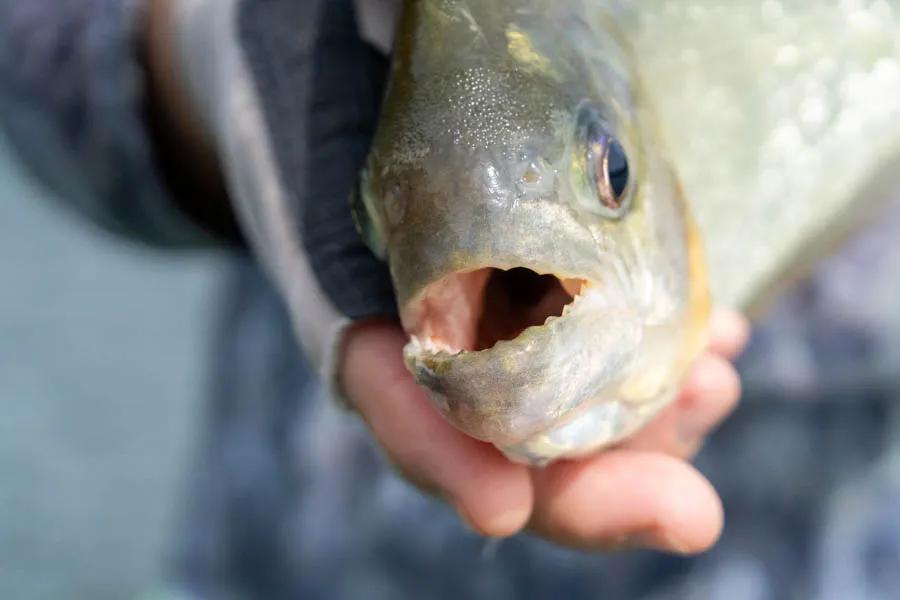
Well, I guessed wrong. Although I had a tight grip on the piranha with my right hand, its jaw seemed to have the ability to telescope outwards just enough to reach my fingertip. Matt let out a schoolgirl scream, while I remained calm, yet blood began to pour from my fingertip. It was only then that I grabbed my hemostats to remove the fly from its mouth. We let the fish go, and after a quick pic, I rushed to my room, where I knew I had some antibiotic ointment and bandages. Thankfully, I was able to bandage my fingertip and continue fishing for the rest of the day. I don’t know that many people need to hear this, but maybe don’t tempt fate the next time you need to remove a fly from the mouth of a piranha.
I do not consider myself an expert at boat dock fishing at Agua Boa Amazon Lodge, but in my brief experience, just about any weighted nymph should work. Because there are so many piranha, I would recommend the largest tippet size you can get away with and still thread it through the eye of the hook, and for that reason, I wouldn’t recommend very small flies. And most importantly, don’t do dumb things like stick your fingers near the mouth of a piranha, especially when in the middle of the Amazonian jungle.
How to catch the fish of a lifetime while fly fishing in the Amazon
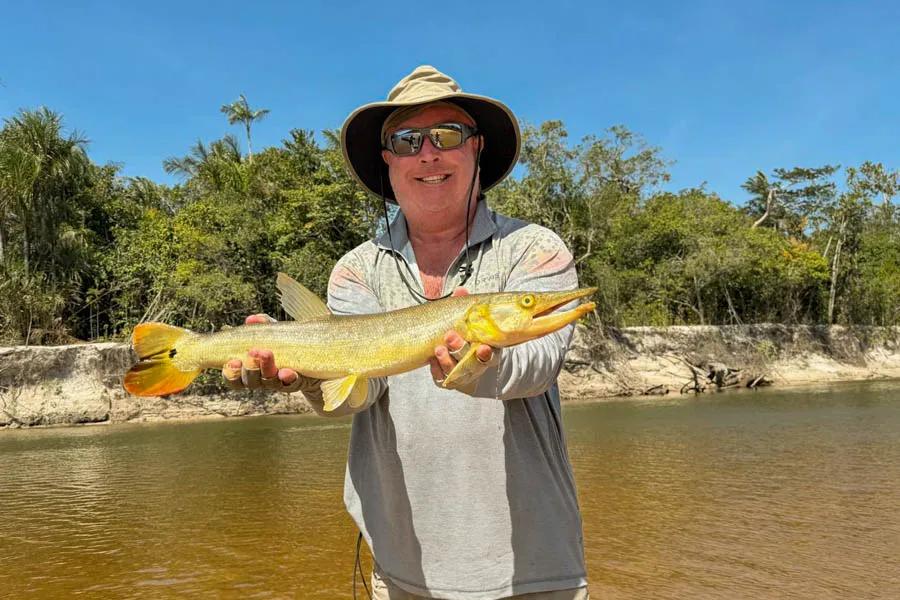
Later in the week, Scott and I fished with guide Joseph, who has been guiding for Agua Boa Amazon Lodge for decades. Joseph has the furthest upstream beat and likely travels further than any other guide at the lodge. I don’t recall how long the boat ride was exactly, but it was longer than the others by a good amount. Joseph’s beat is known for big peacocks, and last year we were lucky enough to spot and photograph a couple of capybara while with him, so I was excited to see what the day had in store for us. Fairly early on in the day, we had some great shots at arowana and managed to hook a few, and Scott landed a bicuda fish, which Joseph seemed impressed by its size. Another face only a mother could love (the bicuda, not Joseph)!
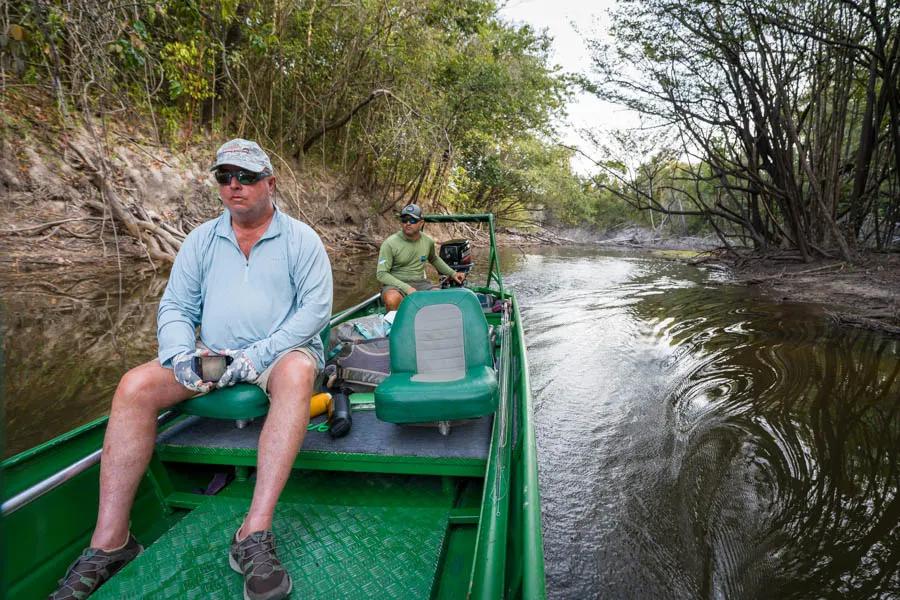
We took a lunch break after a fun morning. Most lunch breaks tend to be about an hour long. The guides work hard poling the boats all day, so I know they appreciate the midday rest. Joseph surprised me a bit this day and asked if we were ready to fish again after a much shorter break than usual. Of course, Scott and I were game, and it was very clear Joseph had a lagoon in mind as his eagerness to dine and dash was very apparent.
We took a short walk to the lagoon, which led to some hesitation. Scott is due to go in for two knee replacements later this year, and the entry to the boat was muddy and had quite a bit of deadfall. Also, the boat that was tucked away at this lagoon was pretty dilapidated and didn’t have a casting brace. I asked Scott if he wanted to bail on this lagoon and head back to the river, but he wanted to give it a shot. We carefully got Scott into the boat. He mentioned he wasn’t sure he was going to feel comfortable fishing out of this boat due to the lack of a knee brace, so I stood up to fish.
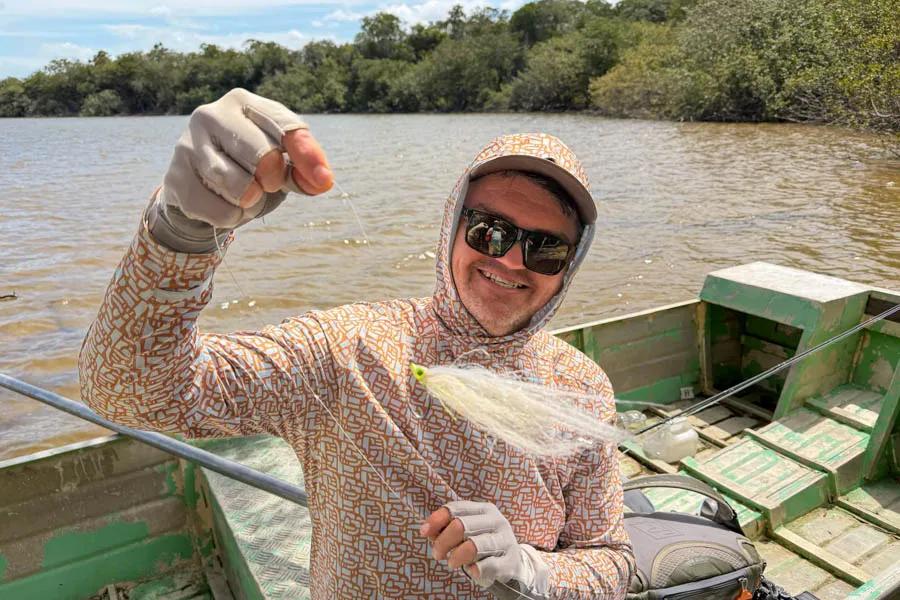
Within seconds of pushing the boat from the bank, Joseph started yelling, “big peacock”. And I proceeded to catch a few big ones. A good start. I asked Scott if he was ready to give it a shot, but he said, “Keep fishing”.
We then started to make our way through a long and narrow lagoon, and then emerged into a larger lagoon. Suddenly, we heard a splash on the surface near the far bank. I quickly looked up and could see the back of a big arapaima and the large ripples it left behind.
Joseph yelled “arapaima!” and he immediately started to pole in its direction. I had cast to several arapaima already this week, but not yet with Joseph. I quickly asked him for some guidance as to where he wanted me to cast. He said cast just over it and let it sink. Because the fish had surfaced so close to the bank, I was able to visualize a landmark along the far bank to maintain a visual on where exactly it surfaced. In previous experience, the arapaima often surfaced in the middle of a lagoon and required a bit of poling to get into casting distance, but it was easy to lose sight of exactly where those fish had surfaced, so the casting was a bit more blind. In this case, I had a great visual on the bank as well as a good sense of distance from the bank.
Joseph got me into position, and I made a cast. It felt as good as it could, with my fly landing just beyond the fish about 5-10’. “Let it sink”, Joseph said to me, so I waited for his direction before I started stripping. He had already instructed me to strip slowly, but I mimed for him my version of a slow strip and asked if it was ok and he agreed: “Ok, strip slowly.”
The tension was palpable at this point. I stripped slowly, but as expected, there was no love.
“Cast again,” Joseph directed me. I cast again, and my cast was nearly identical to the last. I let it sink and waited for further instruction. After letting the fly sink for about 10 seconds, Joseph directed me to strip slowly. I did exactly that. After about three slow strips, I felt tension…it’s a fish!
“What is it?!” I asked Joseph. In my mind, there was no way it was the arapaima.
“Catfish?” I asked Joseph.
Joseph responded, “Arapaima, big arapaima.”
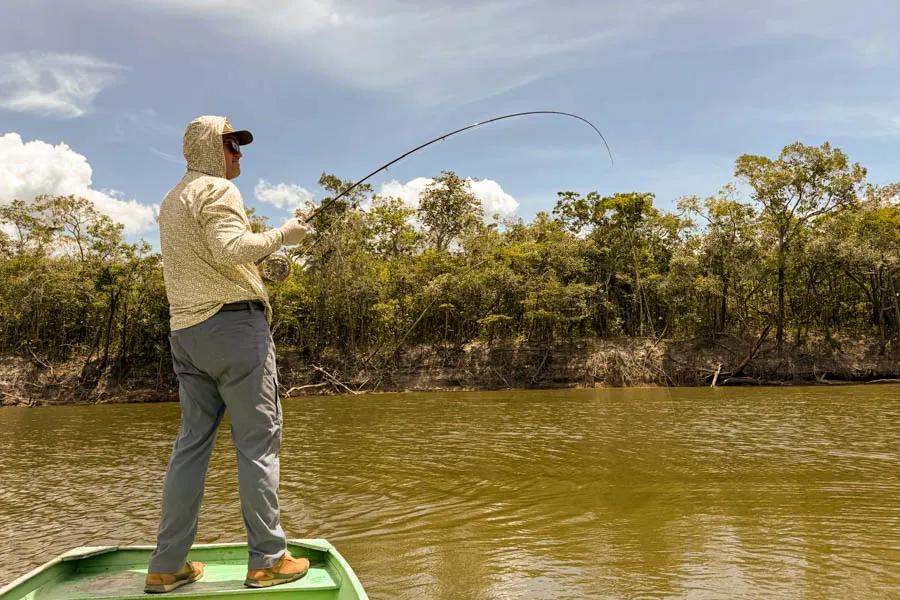
I was in disbelief, but I was as focused as I could be and was able to get my slack line in order. I maintained good tension, but not so much that I would break the rod. I’m focused, I’m excited, I’m in disbelief, I'm hooked up with the biggest fish of my life! I quickly reeled up any slack line I had and started ramping up my drag. While all this was happening, I was wondering to myself how the hell are we going to get this thing landed…we are in a relatively flimsy boat, we are surrounded by submerged trees—some alive and some dead, but undoubtedly there are a bunch of snags under the surface that are not visible.
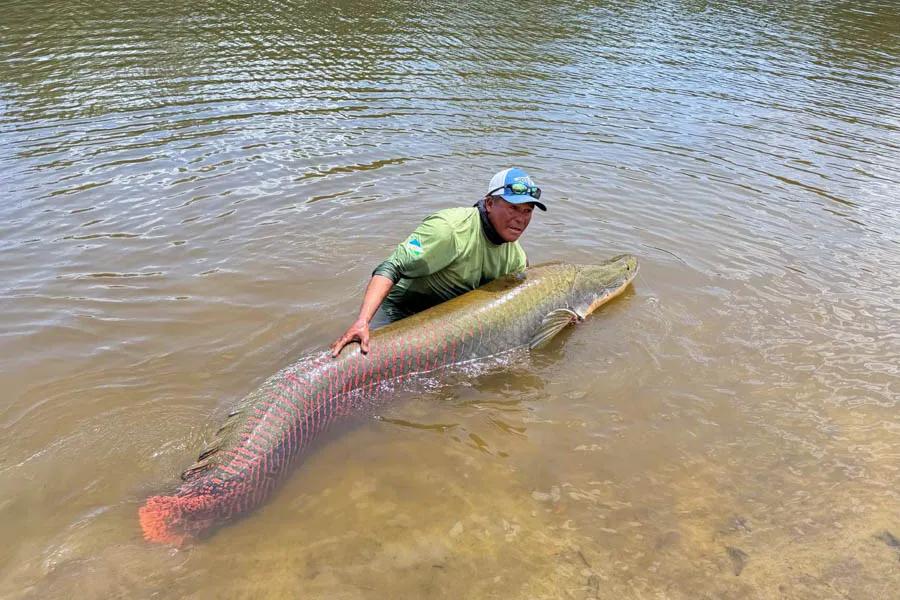
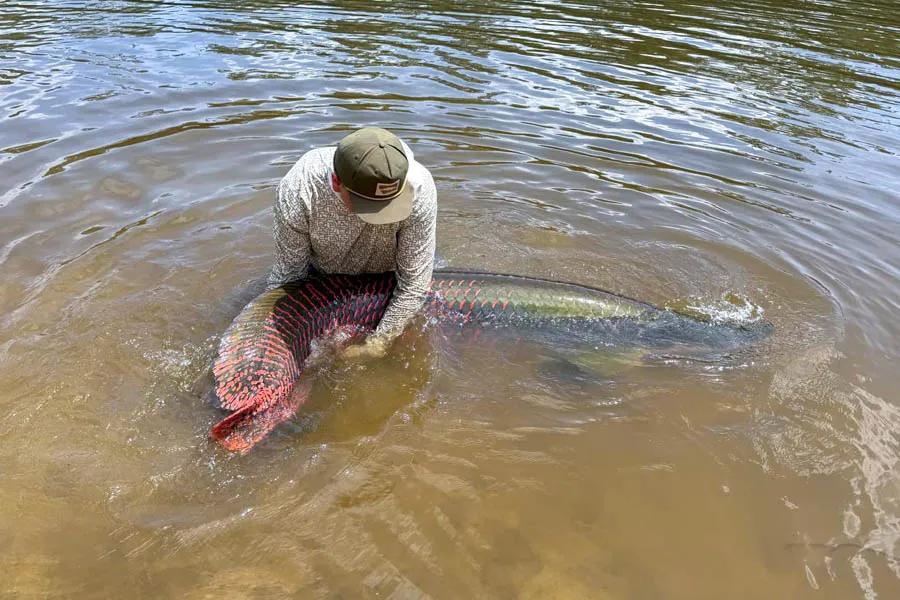
At this point in the fight, I could feel the fish swim up to the surface, and suddenly it exploded out of the water. Expletives poured out of my mouth as I was in total shock. The fish was as big as I am and had bright red scales. I’ve only seen videos of stuff like this. Seeds of doubt crept into my mind: "There is no way I’m going to land this thing. But, my knots are good. My guide is talented. And my boatmate is as good as they come."
After the fish surfaced, I could feel it start to swim away from me. With my rod doubled over, I increased the drag tension and kept reeling when I could. For every yard I gained, I felt like I would lose two when it decided to swim away from me. It seemed to want to return to the same spot where I had hooked it initially. For about 45 minutes, we repeated a dance where I worked my butt off to gain a few yards, it would move to the surface to jump or gulp air, and then swim away from me, losing all of my hard-earned gains. The fish jumped two or three times at first, but eventually I could tell it was getting tired and would only roll on the surface after that.
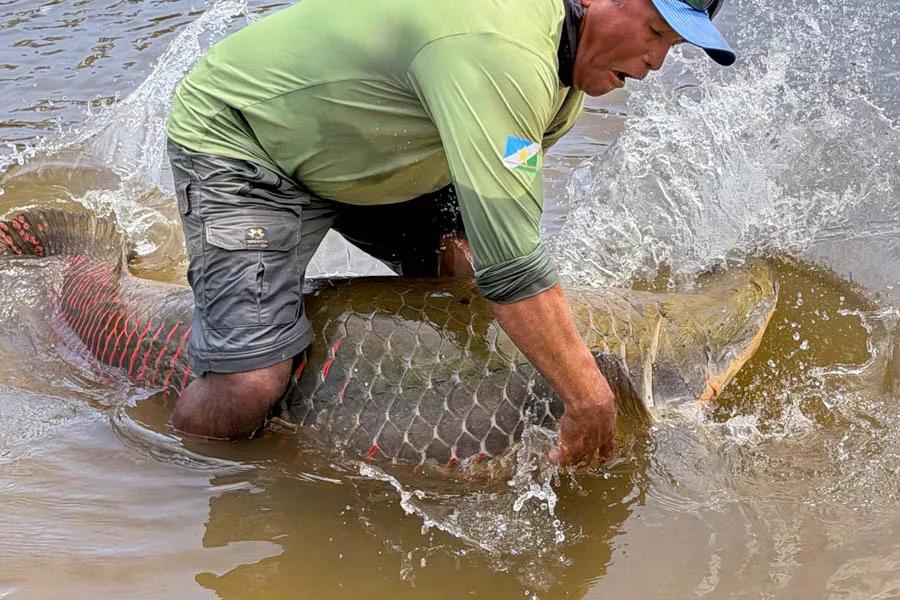
At some point in all this, Joseph had poled us backwards to a small sandy beach on the far bank from where I had hooked the fish. I nearly fell off when we hit land, but I managed to stay on board. I decided to carefully maneuver myself out of the boat and onto land. This move allowed me to better angle the arapaima away from trees and snags that were located to both our right and left sides.
My right bicep was burning and felt like it could tear at any moment. Joseph urges me to keep reeling. At some point, I switched arms to give my bicep a break, but that puts a pause button on the reeling, so I switched back as soon as I felt some relief. This massive beast was getting closer to shore with each turn of the reel. Joseph prepared to land the fish by getting into the water. I wasn’t sure what his plan was, but I trusted he knew what to do. I eventually was able to reel and muscle the arapaima to Joseph. Once the fish was within reach of Joseph, it sure looked like the fish was bigger than he was, but he attempted to bear hug it into submission.
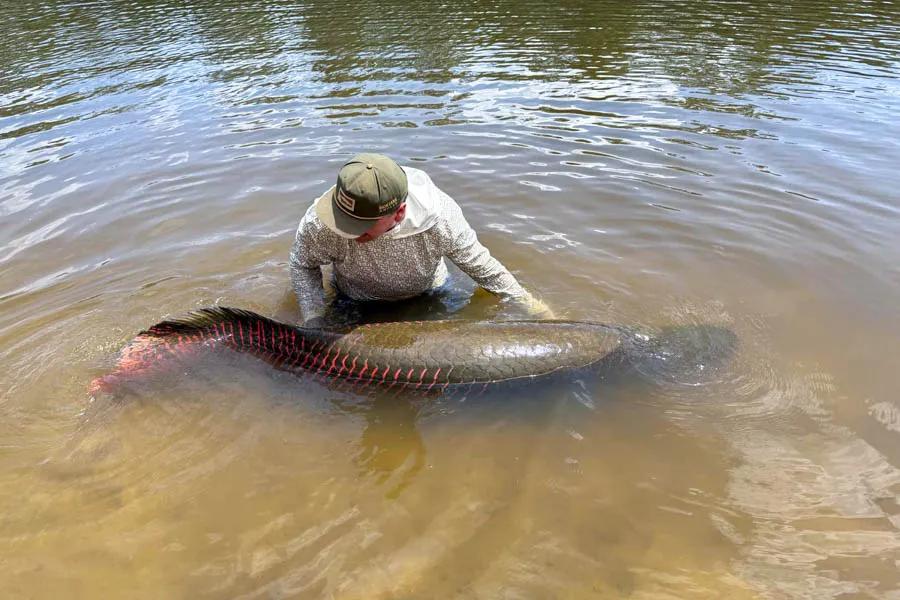
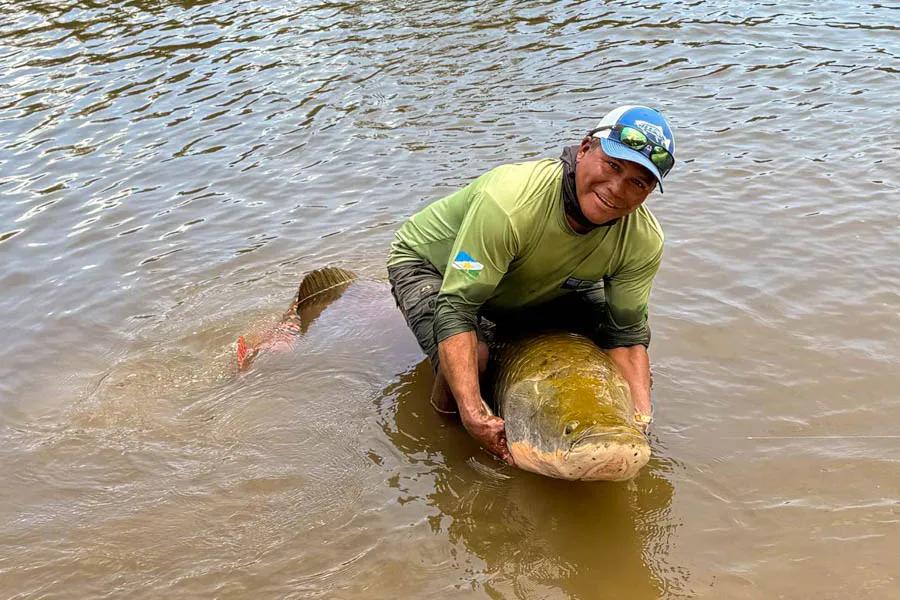
He finally got it wrangled. Holy s**t! The fish was bigger than I expected. I laid the rod on the bank and joined Joseph for a picture. But, a great prey like this never gives up easily, and of course, Joseph loses control of the fish at this time, and the fish begins to swim into the depths again, along with the rod!
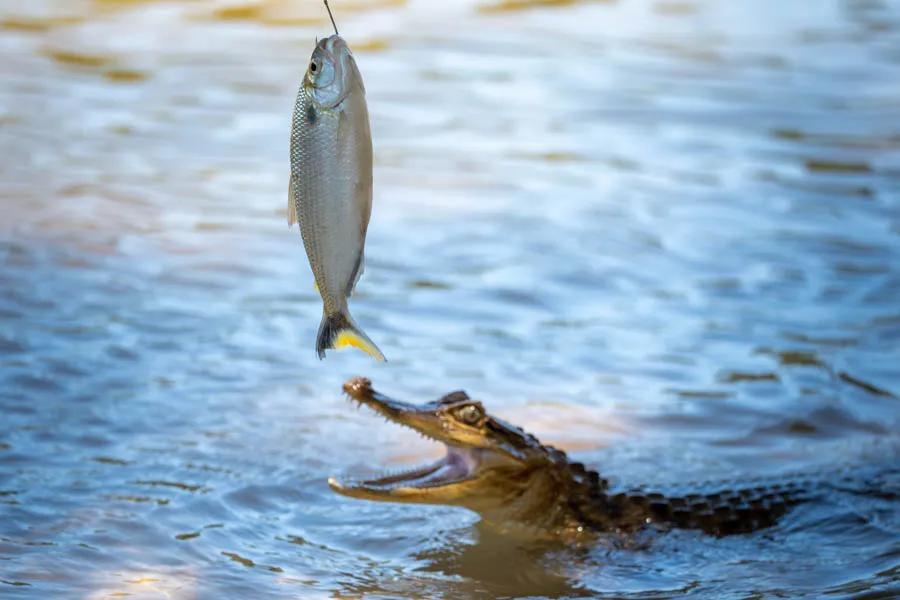
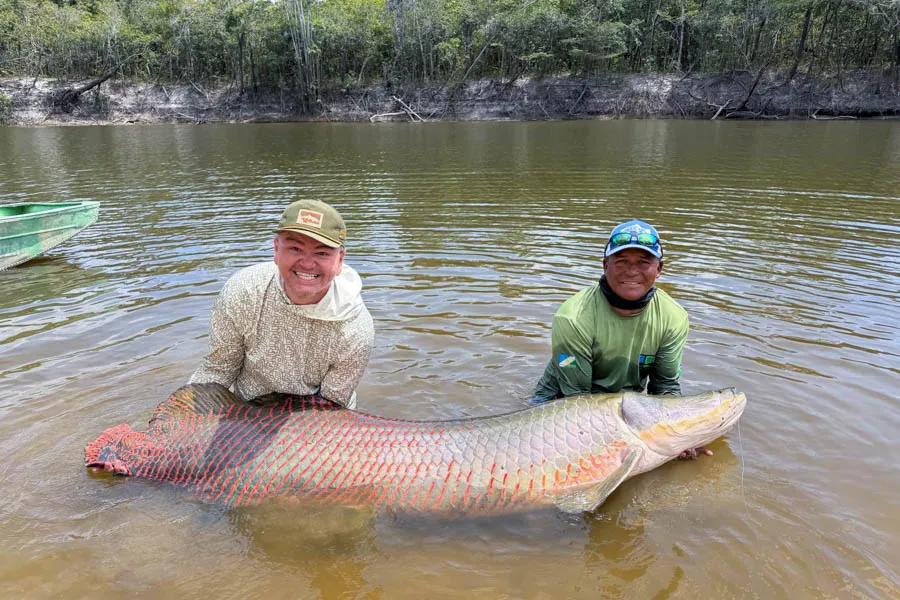
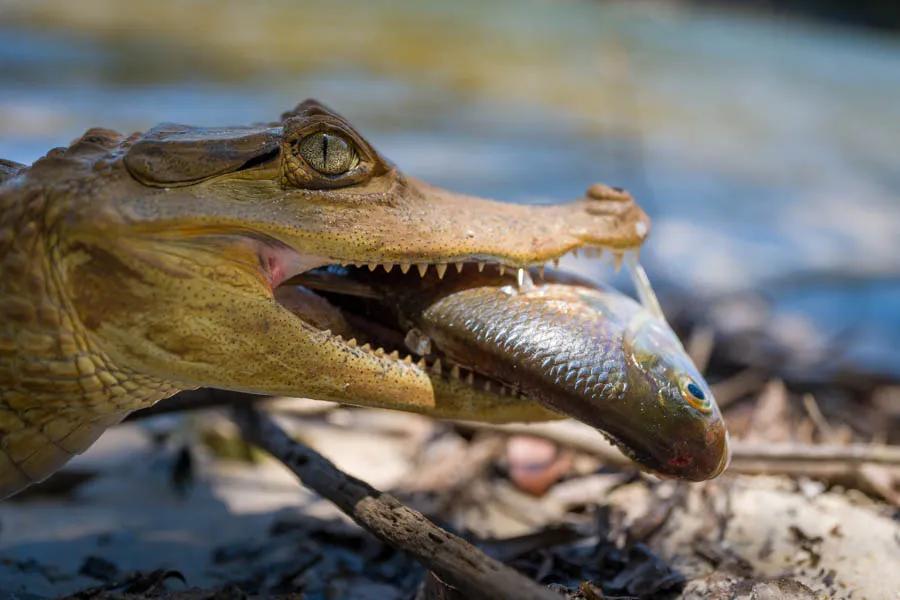
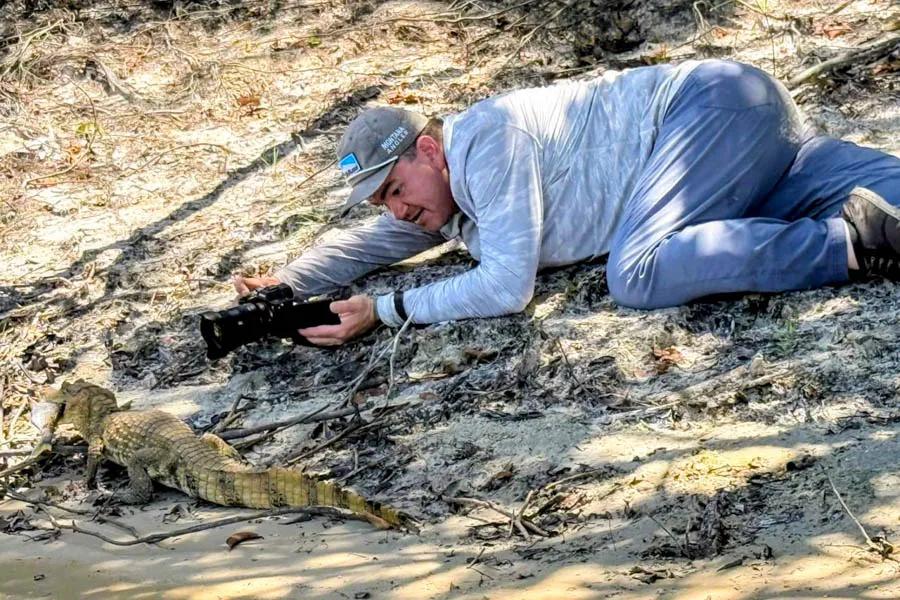
Thankfully, my fly was still hooked deep into the fish’s mouth, and we were able to get it back under control quickly and into Joseph’s arms. It was then my turn to hold the fish for some pictures. Just trying to get a handle on this thing was nearly impossible. It was heavy and slippery. Also, about this time, a nearby caiman took an interest in what we were doing and started to make some sort of barking noise as it moved towards us. It was hard to focus on the fish of a lifetime when I was also at risk of being hunted at the same time.
We snapped some pics, shared some laughs, and finally got the hook removed from the fish. My fly, which was one I had tied earlier that week, was deep in its mouth. To remove it, I was required to stick my arm into its mouth up to my elbow before I was able to reach the fly. It was hooked perfectly. By far one of the happiest moments in my fishing career. I am grateful to Joseph and Scott for their efforts, including Scott’s insistence on getting me to smile while holding the massive fish, along with others throughout the week. I’m not sure his encouragement was as necessary for this particular moment, but it didn’t hurt.
After all that, Scott was ready to fish. Although he was hesitant to fish without the standing brace, something about the past few fish encouraged him to give it a shot. Joseph pushed out from shore, and we continued to move down the lake, as we hadn’t made it very far yet despite being there for well over an hour. It wasn’t long before Joseph started to spot more peacocks. I don’t recall exactly how it all went down, but there was a period where Scott caught a peacock on every cast for several casts, and many of them were some of the biggest we had seen all week. I don’t recall how many peacocks Scott was able to land the rest of the afternoon, but at the end of the day, both Scott and I experienced one of the very best fishing days of our lives.
Where do Agua Boa Amazon Lodge guides like to fish in low water
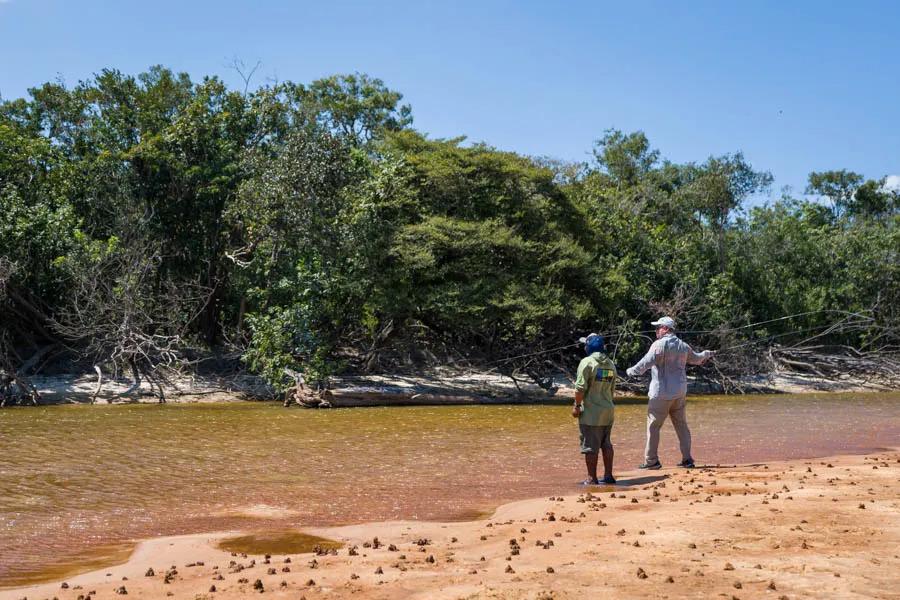
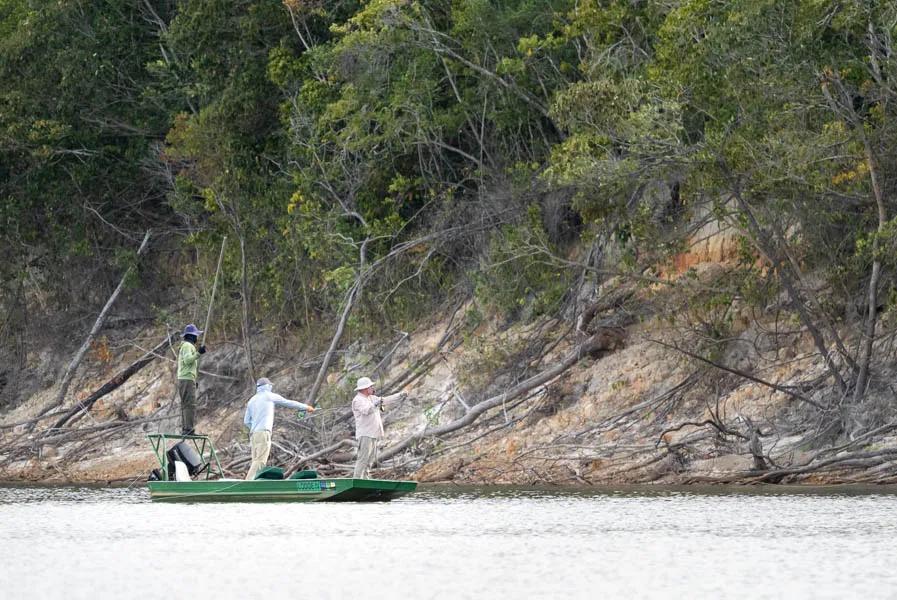
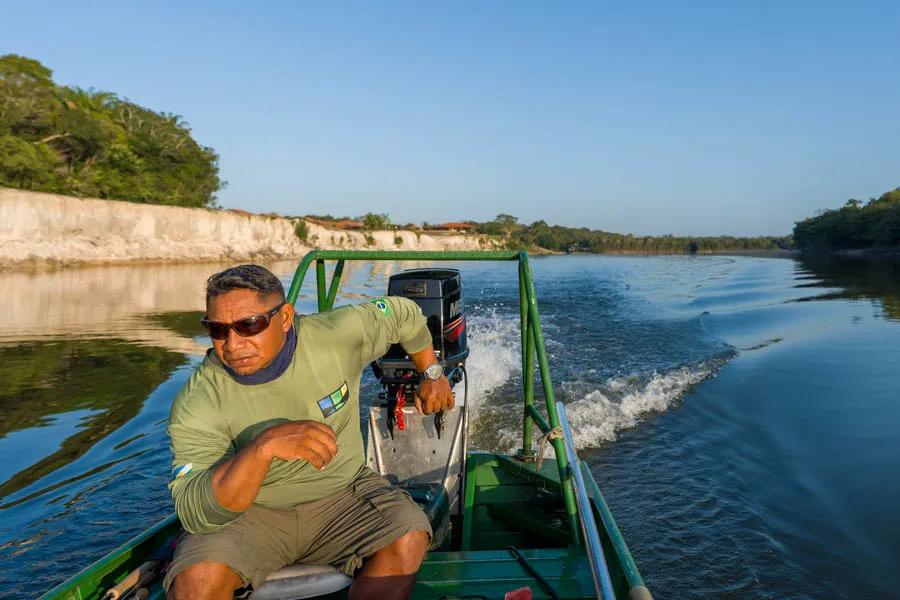
Similar to my first experience at Agua Boa Amazon Lodge, the river conditions were on the low side, which made for some slower commutes in the morning to get to our different beats. Most of the guides run boats with propellers as they are less susceptible to issues caused by sand and sediment, but the guides that fish beats furthest from the lodge tend to run jet motors, which allows them to run shallow water more easily, cutting down the commute time significantly. It is helpful for guests to be able to move around the boat to help distribute weight in a way that allows guides to more easily navigate shallow water, and occasionally it is helpful for guests to be willing to jump out of the boat and even help drag the boat across shallow sand bars. The guides do not require this of guests, but I can assure you that it is appreciated and cuts down on commute times, which in turn increases your fishing time. Some guests do have some challenges with mobility that limit their ability to assist, which is understandable. Although a lack of mobility may limit some of your fishing opportunities at the lodge, the guides are accommodating, and each boat has casting braces that can be installed for more stability while fishing. Also, it is often underestimated how much effort is required to fish from a standing position without support.
How does fly fishing at Agua Boa Amazon Lodge go each day
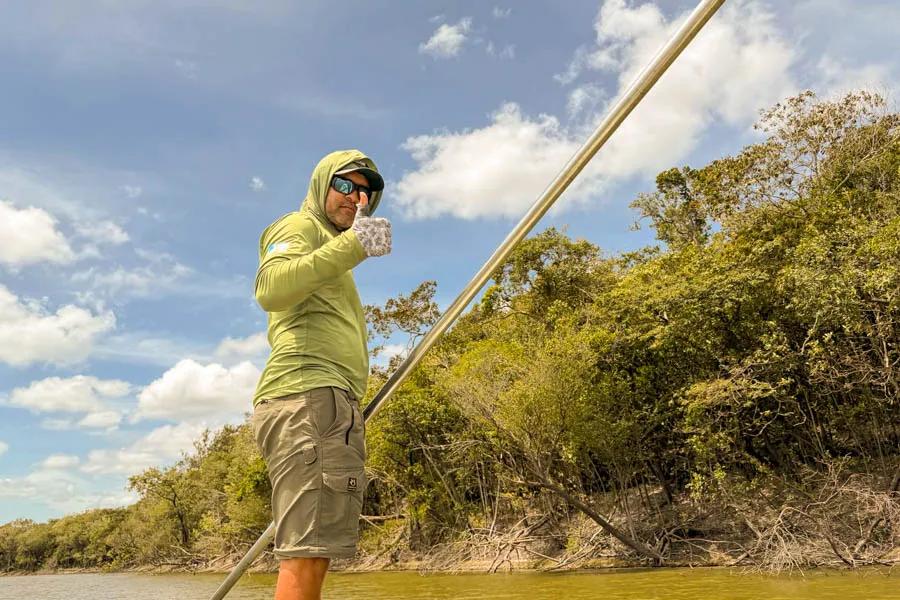
Guides rotate through the group throughout the week. You typically do not fish with a single guide more than once. Each of the guides has their beat or section of the river they focus on. Within each of the beats, there is plenty of water for guides to rotate through different parts of the rivers, different lagoons, etc. One of my favorite days of this particular week was the day we fished with Bacaba, who fishes the beat furthest downstream from the lodge. Bacaba is also the guide who helped me catch fish from the dock. He runs a jet boat, so although it was a long run, the travel time was sped up as we did is not need to slow down to pass through the shallow sand bars. This is something that I have been told is not a factor when water levels are higher. Water levels can fluctuate by several feet at the lodge, as you can read about in this past trip report from fly fishing at Agua Boa Amazon Lodge, but these guides know the waters intimately, so in high or low water, they run these boats safely and efficiently to maximize fishing time.
What is an exciting fish to fly fish for in the Amazon?
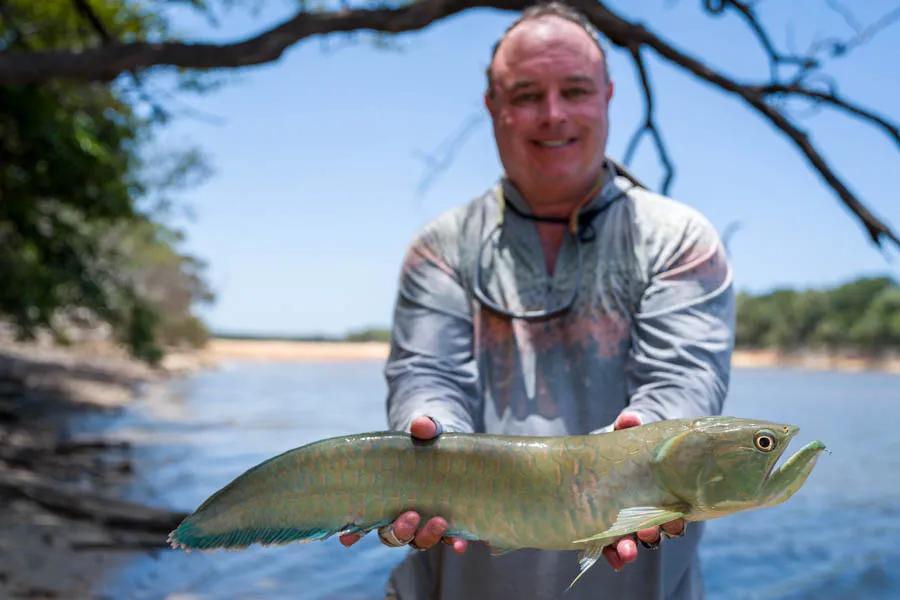
Last year, I briefly saw a few arowana and had some brief opportunities to cast at them, but was left with the impression that they are fairly elusive and are rarely caught. Although that may still be true, this day with Bacaba made me believe that arowana are not only catchable, but one of the coolest fish to target near the surface. We started to spot an arowana in the first place we stopped to fish. After a few sightings, Bacaba had a look through our flies in search of the right pattern. We had a single floating line on an 8-weight rod on board that he had us use. The first fly he picked was a smaller Gurgler pattern called the Bomb Ass Gurgler. This is a fly that Scott had randomly purchased while prepping for the trip. Bacaba instructed us to cast just in front of and beyond the slowly cruising arowana and slowly strip the fly so that it swims right in front of their faces. This is a bit of a departure from the normal techniques used for peacock bass, so it required some thought and practice to get it just right. That being said, it wasn’t long before I had hooked into my first arowana…and on the surface!
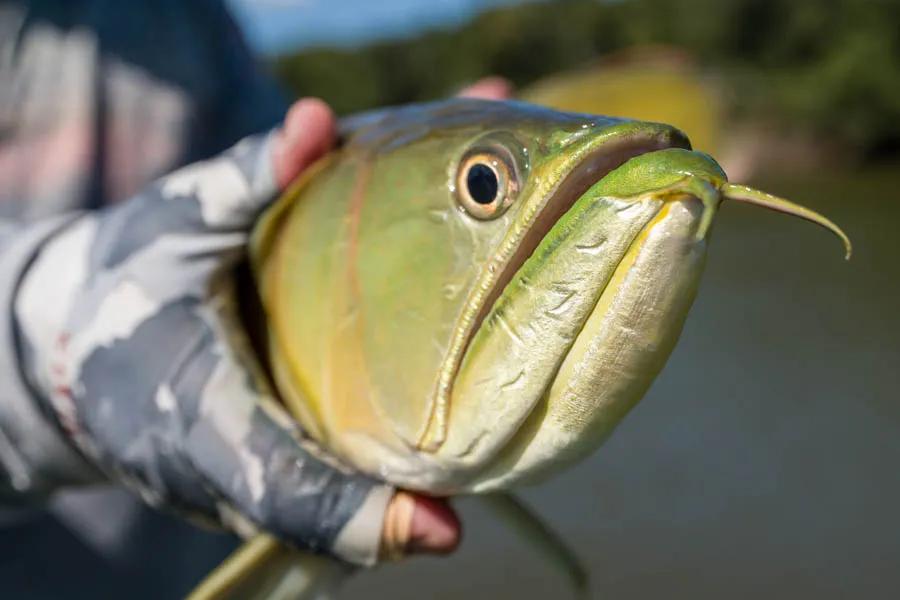
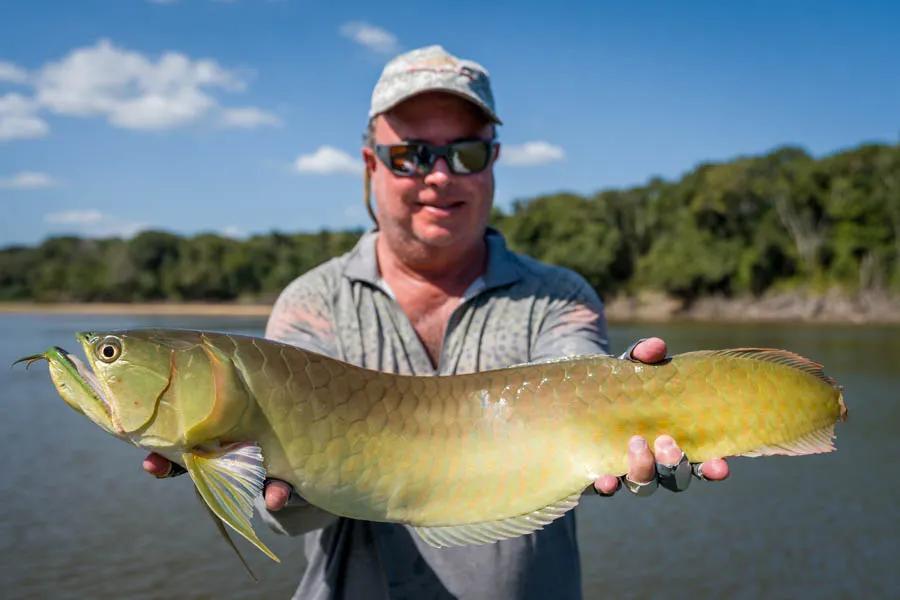
As I am mostly a trout fisherman, it is most comparable to seeing a large cruising trout in a high mountain lake or a large slow-moving river and watching it slowly move towards your fly before sipping it. Sight-fishing like this is one of the best experiences in fly fishing, and I will never get enough of it. Now I was in the middle of the Amazon, casting to fish that looked like they were around when dinosaurs roamed the earth. Hard to beat, and every trout fisherman should experience it.
On this particular day, Scott and I had several shots at arowana and at times were surrounded by pods of dozens of them. They weren’t always willing and eager to eat our flies, and it wasn’t a numbers game by any means, but if I ever get the opportunity to return, I will be ready and anxious to cast to as many arowana as possible.
In addition to fishing the Bomb Ass Gurgler, which is about 3-4” long, we also fished Sparkle Minnow Baitfish (not to be confused with the Sparkle Minnow used for trout) in chartreuse and white, as well as pink and white, with good success. The Sparkle Minnow Baitfish is also about 3-4” long and is unweighted, so it hovered just below the surface and was visible the entire time. Although not technically a surface pattern, it felt like dry fly fishing as the fish were cruising near the surface, and it was 100% a visual game.
I have discovered my new favorite fish to target, if only they lived in Montana.
What is fly fishing for oscars in the Amazon?
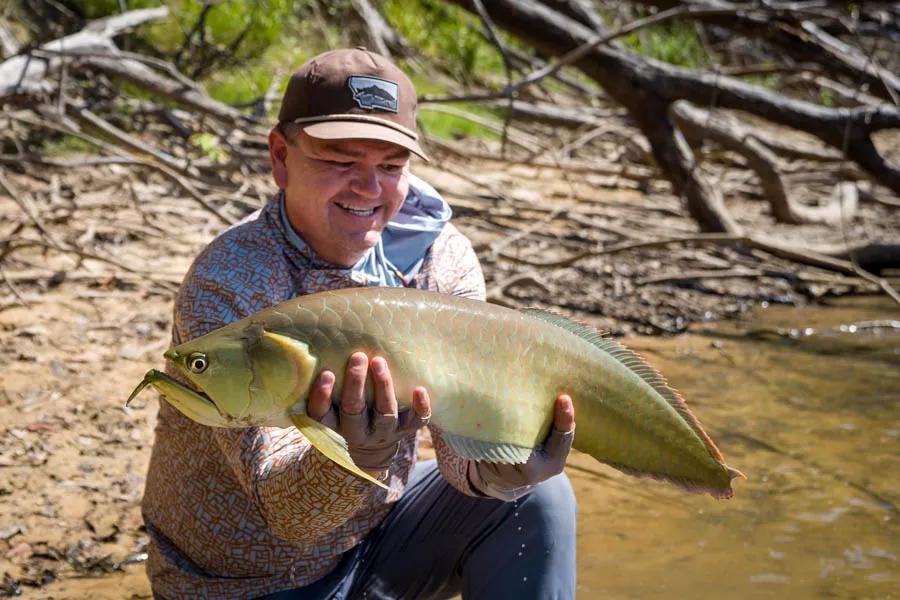
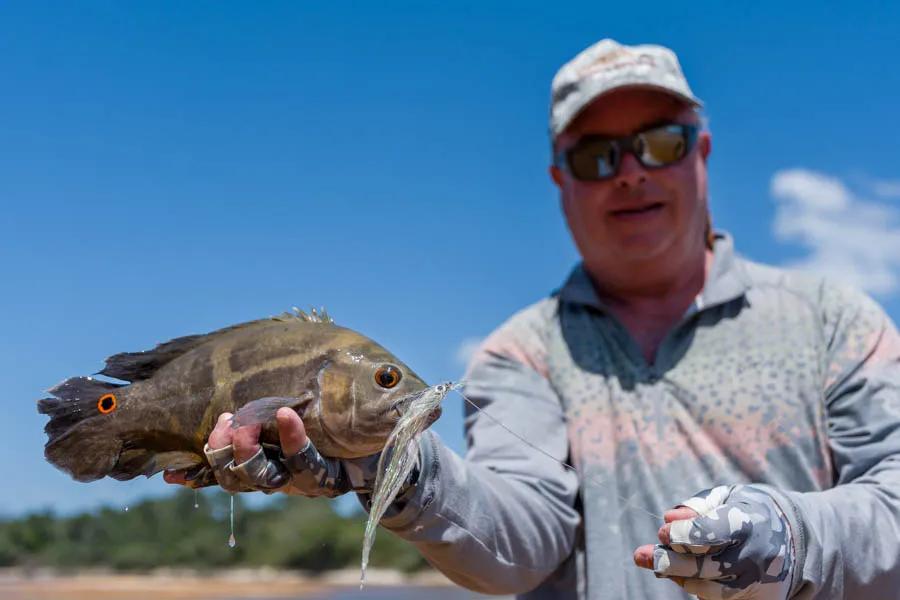
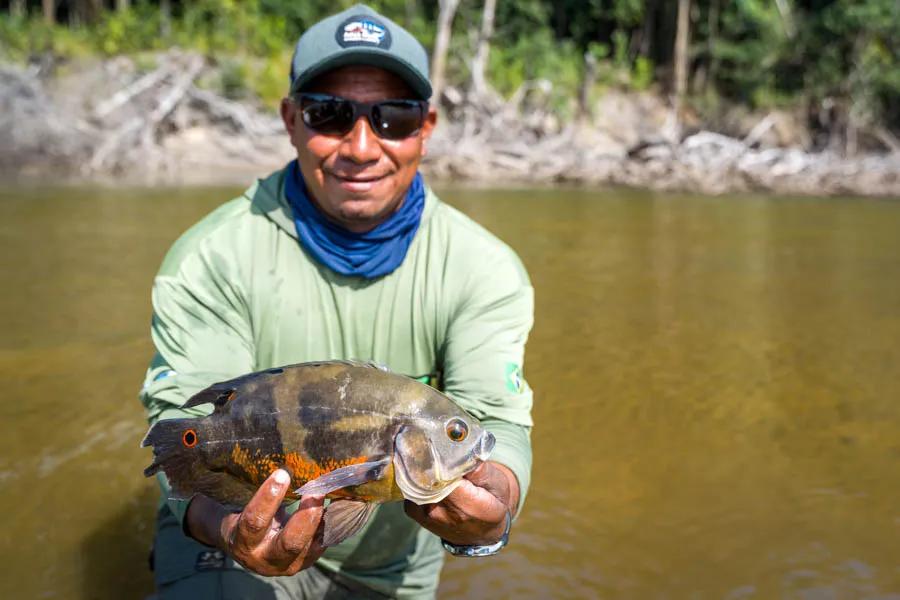
Another cool fish that we were able to target for part of the day with Bacaba were oscars. Targeting Oscars also had a visual element to it, although a bit more challenging to see them as they hung out in slightly deeper water than the arowana and are considerably smaller on average.
The oscars seemed to hang out in muddy areas near lots of structure near the bank, which is a little different habitat than the large peacock bass in the Amazon. It felt a little bit like targeting panfish in our local ponds. The oscars seemed to also enjoy the Sparkle Minnow Baitfish imitations. Catching them required a bit more instruction from Bacaba, as he had better visuals on the fish and had us strip and stop on command as he saw fish moving towards our streamers. We were able to catch a few, and similar to catching a panfish, the fight is surprisingly strong relative to their size, and they are beautiful fish.
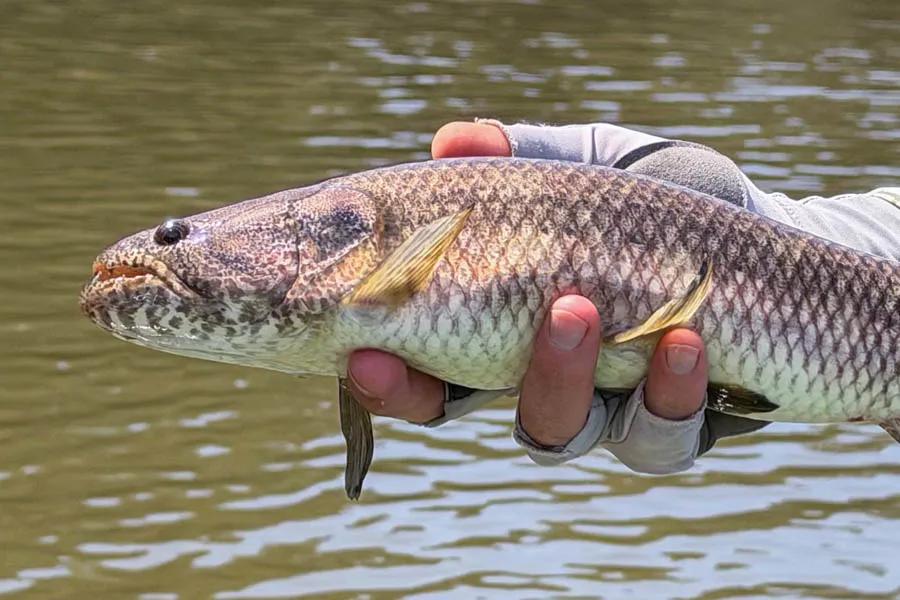
We also caught some wolf fish while targeting oscars, so I get the impression that they enjoy similar habitats. Wolf fish were cool to check off the list, but they have a face only a mother could love. Although one of the main targets while at Agua Boa Amazon Lodge is larger peacock bass, which are best targeted with larger streamers, such as the Flashfire Mushies, fly fishing for wolf fish in the Amazon jungle was one of my more enjoyable days overall, and one of the few days we mostly fished relatively small flies. We did actually catch a good number of smaller peacock bass on the Sparkle Minnow Baitfish as well, which was a hoot and a nice break from casting 6-inch long streamers.
How to discover peacock bass in the Amazon jungle
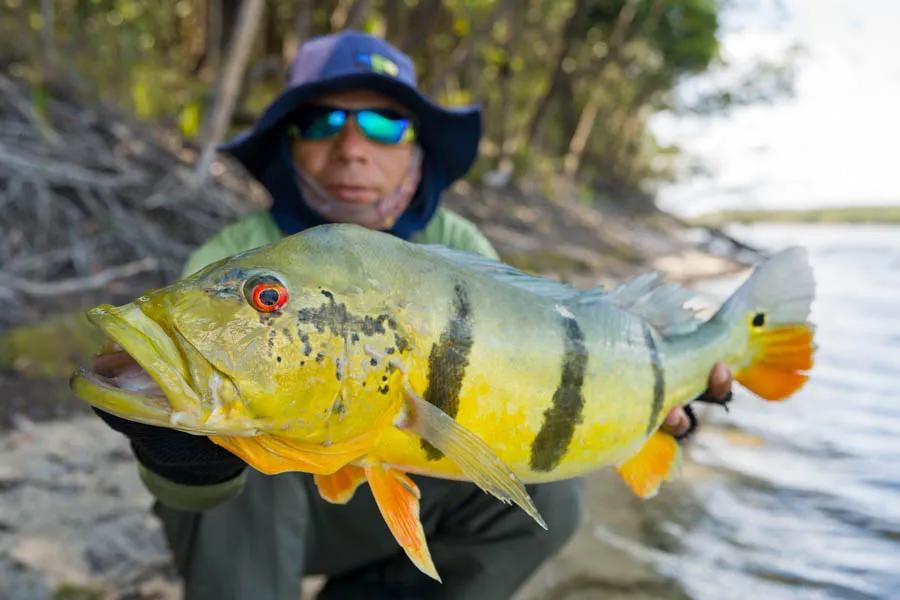
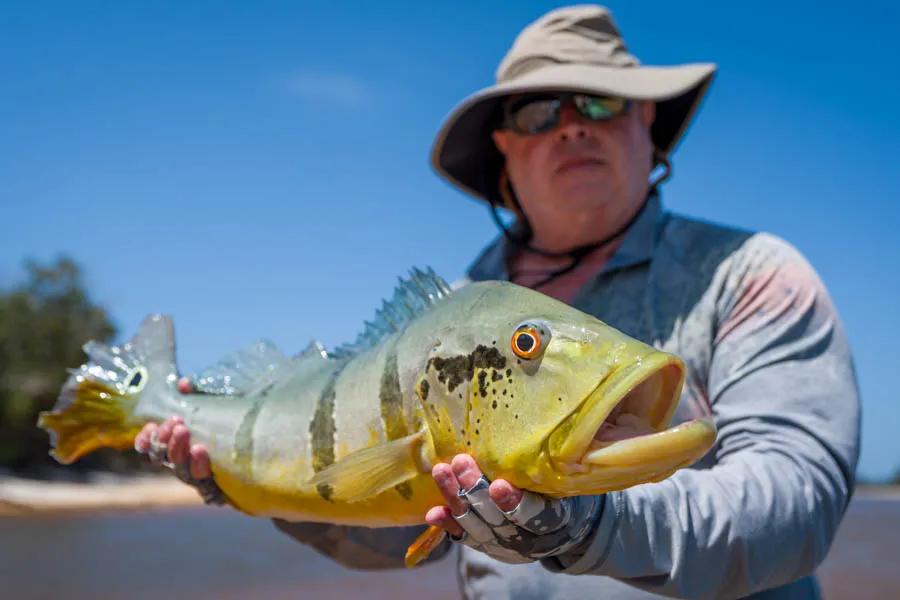
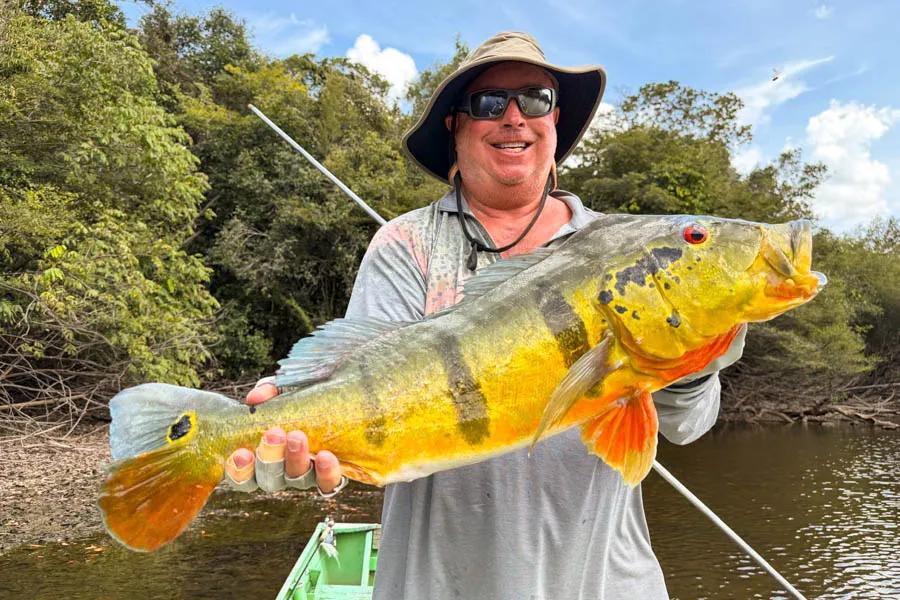
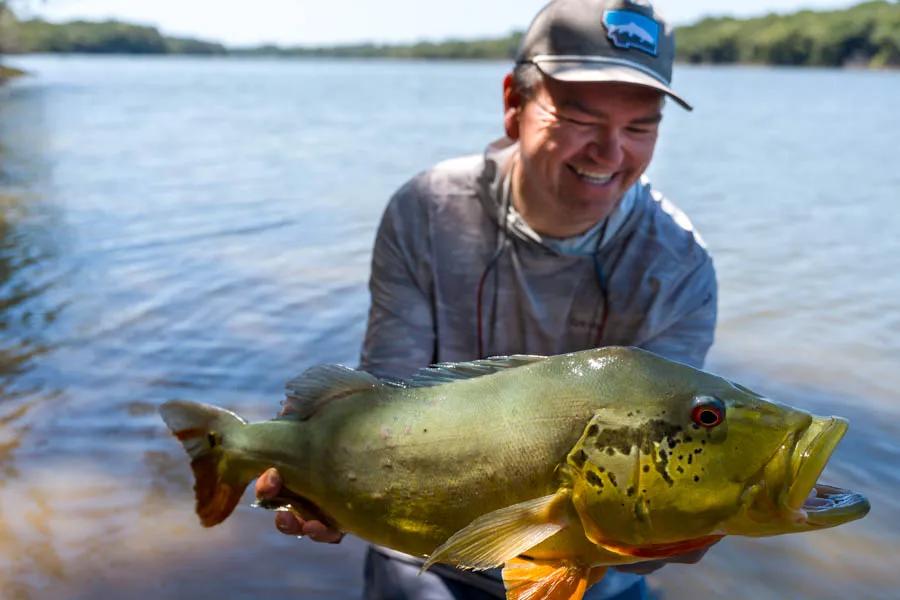
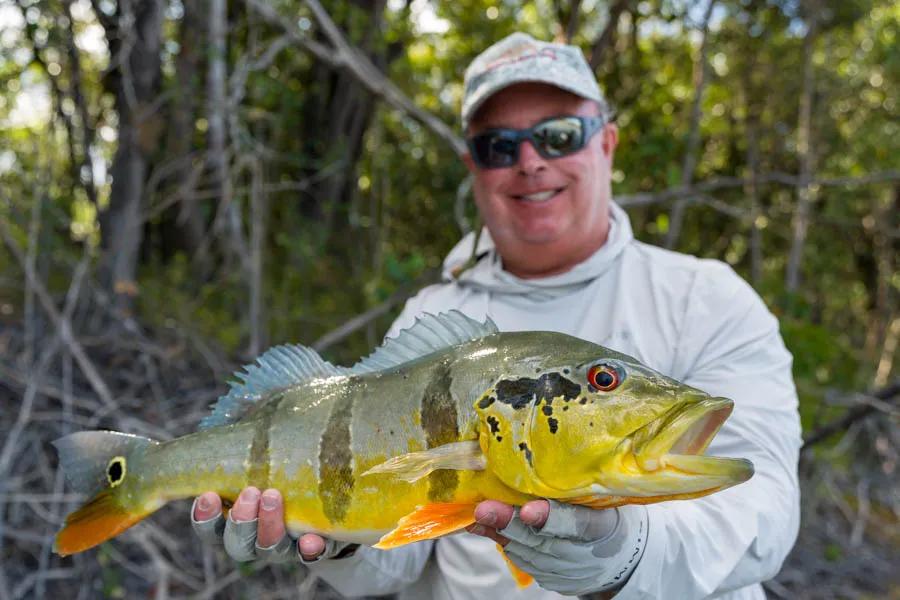
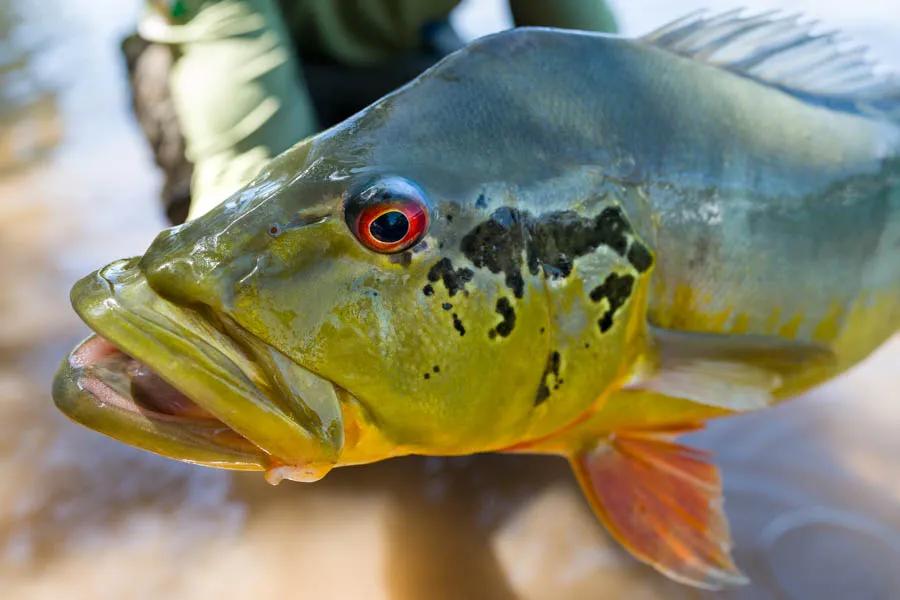
Peacock bass are the primary fish that are targeted while at Agua Boa Amazon Lodge for a variety of reasons. They are plentiful, they are aggressive, they are spread throughout the river and lagunas, and they are fun to target and catch. Not to mention, they are one of the most beautiful fish to grace the end of a fly line.
Their name is a bit of a misnomer as they are not actually bass, but a species of cichlid. The three primary varieties of peacock bass that are caught from the lodge are butterflies, paca, and temensis. Some of these varieties are known by other names, and there is some argument about species differentiation, but I have learned that these are the three most acceptable terms used by the guides at the lodge.
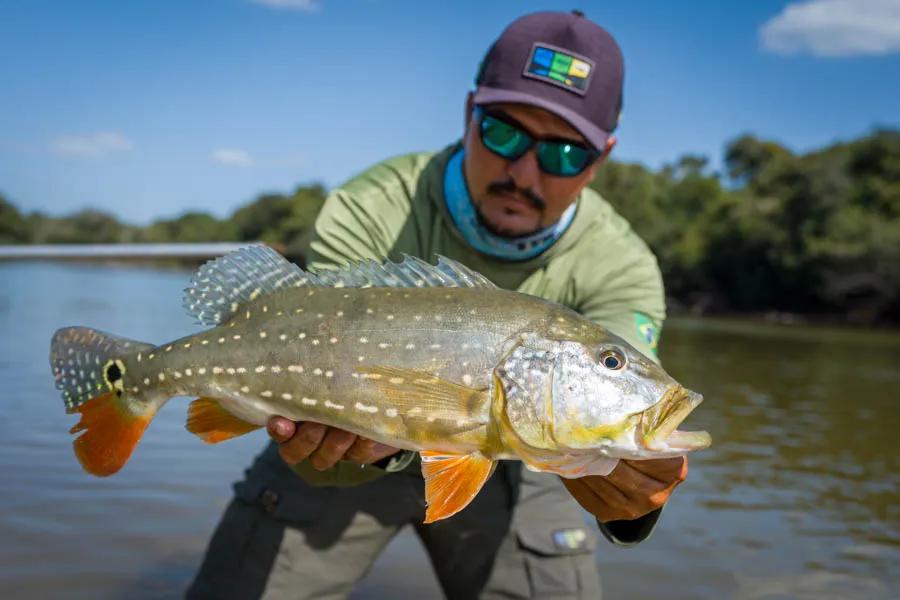
Butterflies tend to be smaller and have the distinct large spots, which earned them their name. Paca tend to be small to medium-sized fish and have multiple smaller spots on them, are less colorful compared to the butterflies, but are much harder fighters on average. Lastly, we have the temensis, which is the biggest of the peacocks and also a very aggressive fish. The temensis tend to have vertical bars instead of spots, and the males sometimes have bumps on their heads, which I believe is more dominant when they are spawning. Although peacock bass are the primary focus of these trips, I would recommend that readers looking for more detailed information about peacock bass fishing to read past trip reports and articles that the Montana Angler staff have written over the years to learn more about them and the best techniques. I will instead focus my trip report on some of the lesser-known species that I was able to check off my list.
Are there other species to fly fish for in the Amazon
Before embarking on this trip, I had the fortune of getting the scoop from Brian, who hosted a trip only a few weeks previous to this one. He mentioned that he saw more arapaima surface than he had ever seen before. That being said, he did not personally land any, but cast to several and believes he hooked into three that were all lost before they were seen.
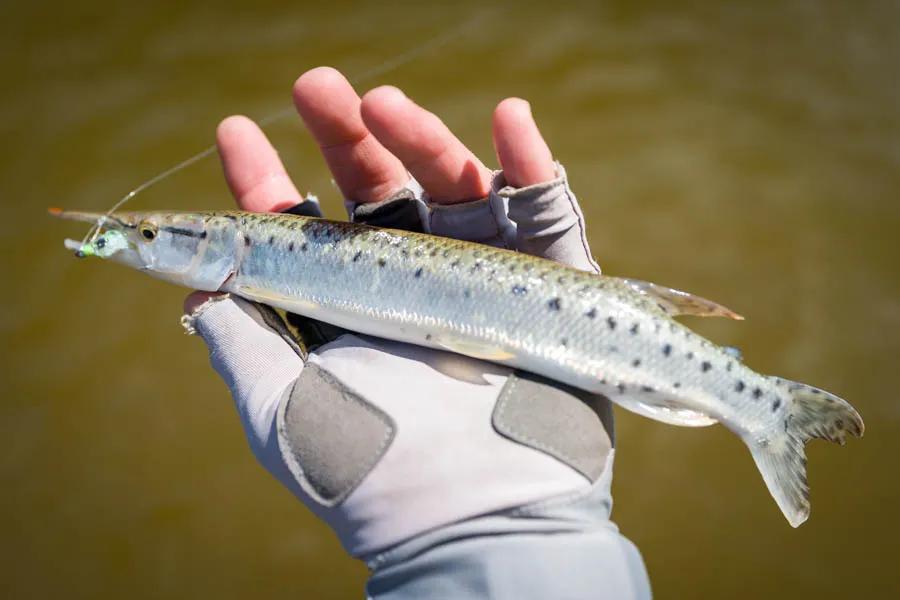
For much of my life, I have been intrigued by and revered arapaima. They are a primary game fish when on a fly fishing trip in the jungle. My impression has always been that opportunities to catch them are few and far between, and although I had some hope that I would get the opportunity to someday wrestle with one at the end of my line, it was very unlikely to materialize. On last year’s trip, I happened to cast towards a few surfacing arapaima in the middle of lagoons, but I had trouble knowing where to cast exactly, how quickly to strip, etc. Although I made a few casts, I never felt like I had a real chance.
Similar to the chances of winning a beauty contest, simply showing up doesn’t count for much, if anything. All this being said, I still spent some time researching arapaima flies and trying to find out what they eat. Most of what I read recommended long, dark colored streamers like black and purple. I tied up a few patterns last year in preparation for that. A couple of the guides seemed excited about those flies last season. I spent a good chunk of time tossing them at the expense of my casting arm. Although last year I did not hook or catch any arapaima on them, my two best peacocks were landed on them. These flies are 9-11 inches long. This year, the guides didn’t seem to show much interest in the same flies and seemed to mostly prefer the Flashfire Mushy style baitfish patterns for most situations. We fished the chartreuse and white, olive and white, and grey and white colors, which are the only three colors that the pattern is commercially available in. The Flashfire Mushy is about 6-7 inches long (if any of you have elementary/middle school-aged children, you may find yourself saying six-seven out loud now and doing some odd hand gestures simultaneously). If you don’t understand the reference, you’re better off for it!
What are the best flies to fish with when at Agua Boa Amazon Lodge?
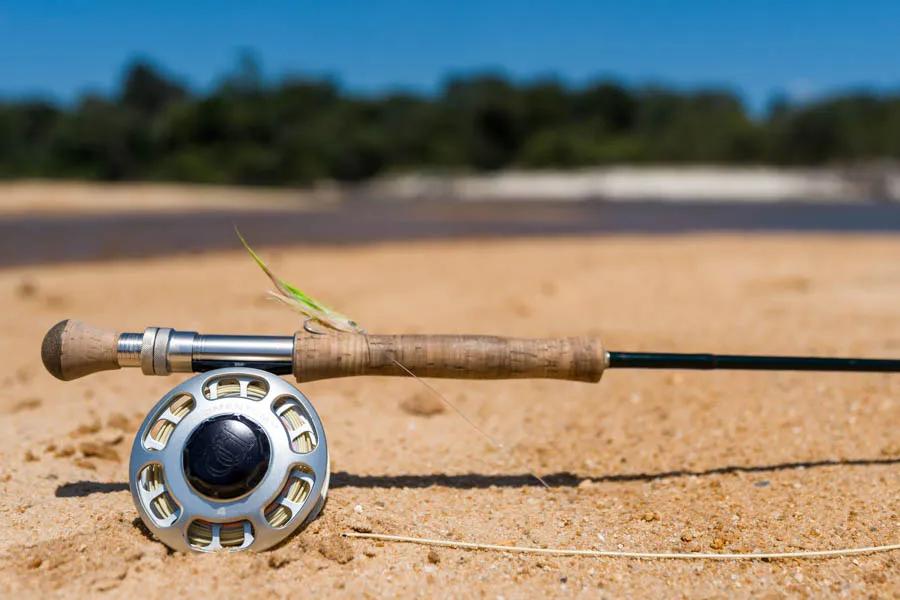
There are a lot of streamers available that would likely fish quite well at Agua Boa Amazon Lodge, but they are mostly tied on hooks that could easily fail if you hooked into a large peacock or if you are so lucky, an arapaima. Because I am a fly tyer at heart, I tied up most of the flies I used for both this year's and last year’s trips. Most of the streamers I tied were very similar to the Flashfire Mushy and tied on a very stout 3/0 hook. I had a good supply of flies left over from last year, but I felt like I was short on some color variants, such as the light gray and white.
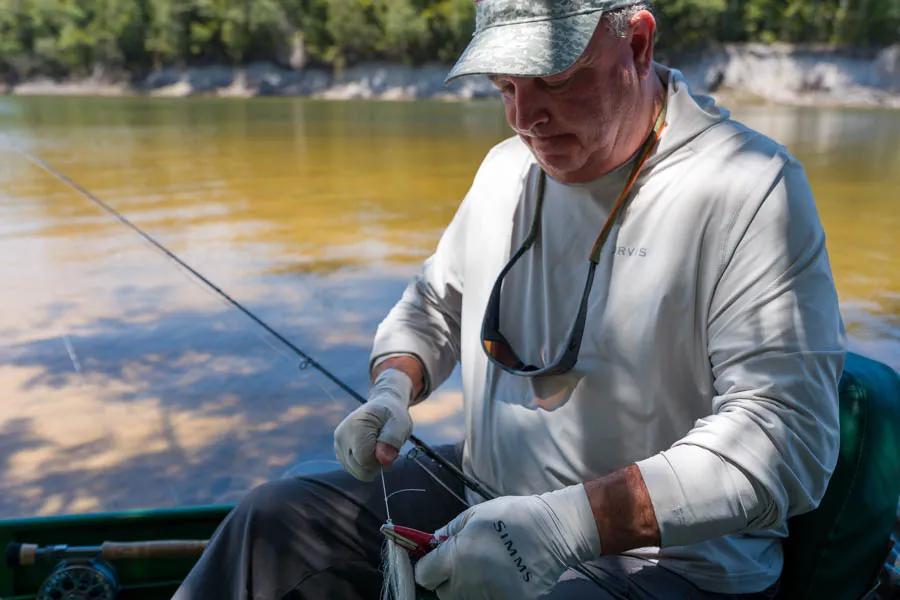
I didn’t make the time to tie any in advance, so I packed a small fly tying kit so I had the option to add some flies to the quiver while at the lodge. The first evening of the trip, I decided to break out the fly tying kit and slap together some lighter colored Mushies, specifically gray and white, which I was out of. I only managed to whip up a couple that night, but I felt that was enough to fill in the gap. The versions I tie average closer to 7 inches long, and in my personal experience, the ones that are tied more sparsely are easier to cast and sink more quickly, which comes in handy when targeting peacocks sitting in deeper water. Both flies turned out to be good additions to the fly quiver for the rest of the week, catching a wide variety of species.
What is the best part about fly fishing at Agua Boa Lodge
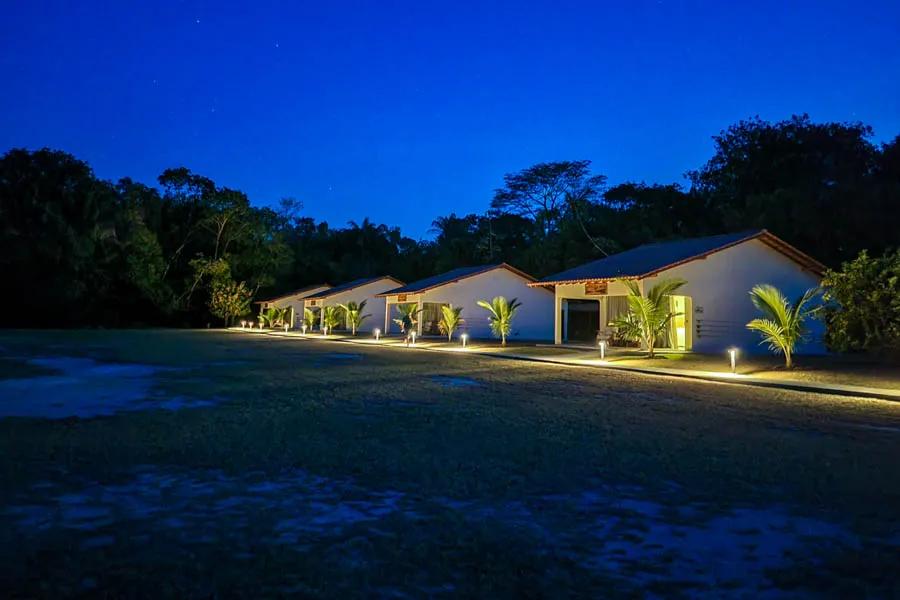
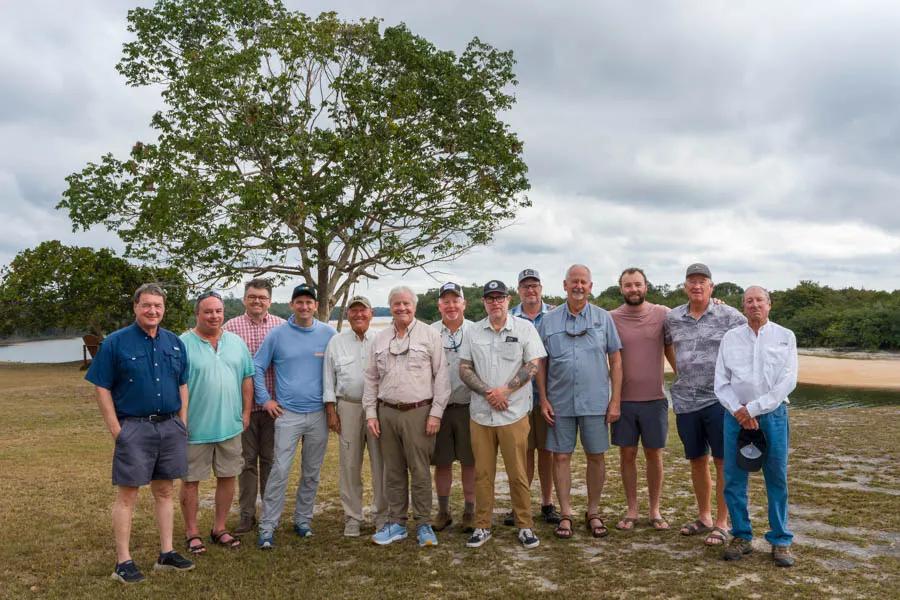
There is so much to unpack from a trip like this, and it's hard to know what to share and what not to share. All of our past Montana Angler Agua Boa Amazon Lodge trip reports all showcase something special about this place. My week spent fly fishing the Amazon wilds out of Agua Boa Amazon Lodge was filled with stories and plenty of fish. Not every day was easy; the wind blew some, the water levels were low, but this place has amazing guides who know how to find fish in any conditions. In the end, it was a great crew of anglers, we had great food, great fishing, shared great stories, and enjoyed an amazing week in the middle of the Amazonian jungle, flailing graphite sticks like madmen.I owe a huge thank you to all the guests, the guides, the lodge staff, and to Montana Angler for giving me an opportunity of a lifetime. I truly cannot wait to go back.
And if you really want to know what it was like, it was epic; purely boy band epic, and you’ll never have to ever tell me why.

I've been fortunate to travel on several Montana Angler-hosted trips. A few years back, Scott and I fished together at Carrileufu River Lodge in Patagonia. We had an epic streamer day there as well on Rio Rivadavia, which was also one of the better days of fishing either of us has ever experienced. I’m excited for our next trip together, maybe on one of our hosted trips to fly fish in Mongolia?
Our return trips will fill fast. Join us in 2027!
For those who love to travel, I strongly encourage you to make a trip to the Agua Boa Lodge in the Amazon at some point in your life. It is simply one of those experiences that is unparalleled and rarely disappoints!